Christ the King: 22 November 2026
Readings: Ezekiel 34.11–16, 20–24; Psalm 95.1–7; Ephesians 1.15–end; Matthew 25.31–end
In the name of the Father and of the Son and of the Holy Spirit. Amen.
How was your week, I wonder?
Me? Well, on Tuesday I should have been
working at the Foodbank,
but I’d rescheduled that with Callum
and instead I went to London.
I had to get up in the dark
and leave the house when it was barely light
to catch an early train
and reach Kings Cross before nine o’clock.
It was standing room only,
and then a crowded tube train to Westminster,
where the heavens opened
as I walked round to Westminster Abbey.
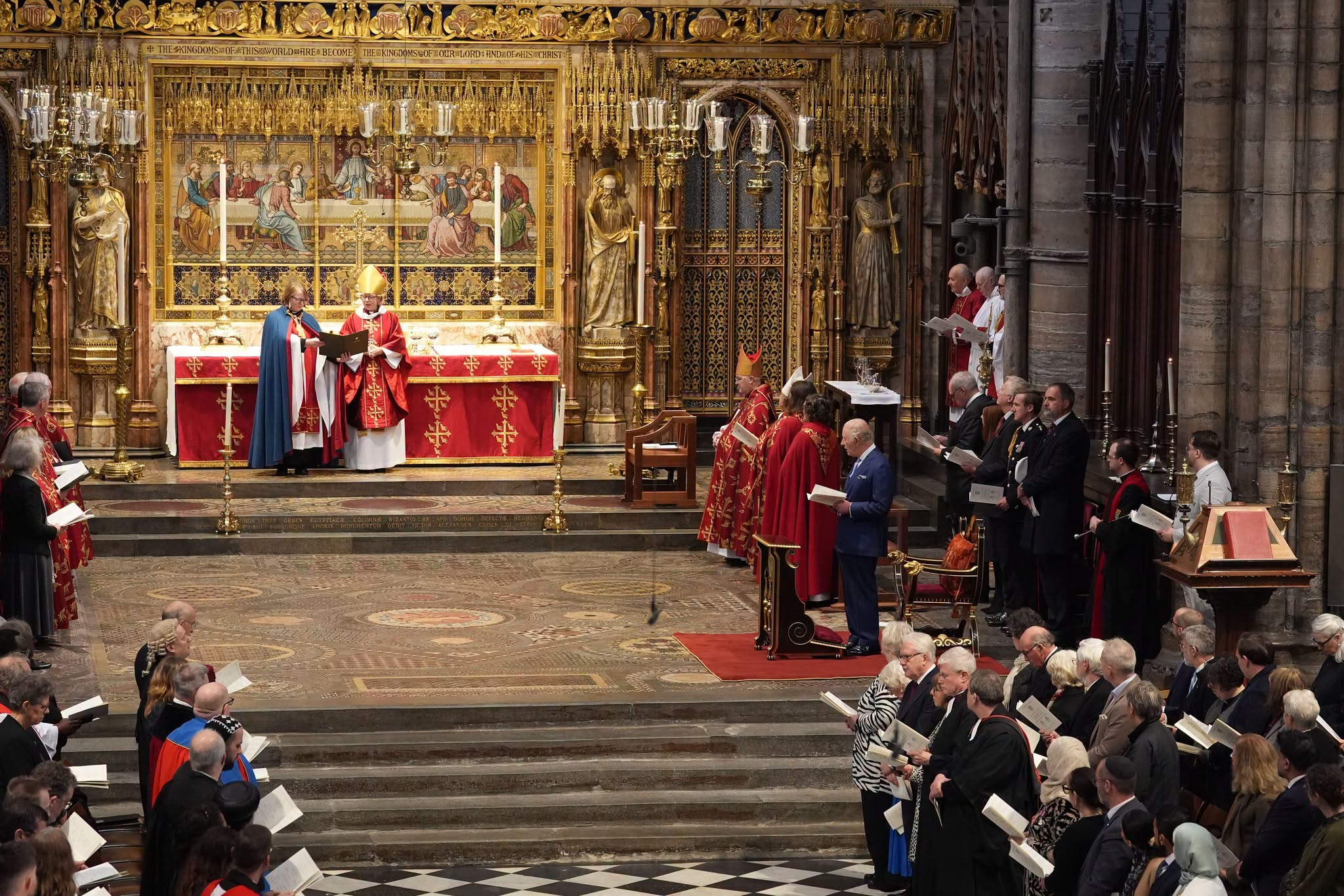
I’d been invited to the service to inaugurate
the newly elected General Synod of the Church of England,
and I had a seat very near the front,
in the third or fourth row.
And just a few feet to my right,
closer than any of you are to me now,
was an ornate carved wooden chair and prayer desk,
all beautifully decorated with gold leaf,
and plush with red cushions.
 |
| Picture:Simon Kershaw |
And sitting in that seat for the service …
was Charles our king.
 |
| Picture: Westminster Abbey |
He’d been greeted in procession with a great fanfare
from the state trumpeters of the Irish Guards,
and at the end of the service another fanfare
heralded the Coronation setting of the National Anthem.
I can tell you it’s quite an emotional moment
to sing “God save the king”
with the king standing so close by.
All in all we were treated
to much of the pageantry and majesty
of church and state.
And then,
and then, afterwards,
on the way home,
I was walking through a crowded St Pancras Station.
And I was accosted by a woman.
I’m homeless, she said.
Could I give her something
towards the cost of a place in a hostel?
Now I don’t know if she was genuine or not,
and if I’m being honest then I must admit
that quite often in such situations
I politely decline and walk away.
Maybe you do too.
Well, what I can tell you
is that it was just a few moments later,
after we had gone our separate ways,
that I tore up – mentally at least –I tore up
the sermon I’d been planning to preach this morning,
the sermon I’d already mostly written.
And on the train home,
with just my phone,
I tapped out much of a new sermon.
This one.
Because there,
presented oh-so-starkly to me,
was today’s gospel reading.
The king among his people,
sitting in state with trumpeters playing fanfares.
And a homeless woman begging for help.
Let’s think for a moment about that.
We heard Jesus tell a parable,
about him coming in glory at the end of the age,
and seated on his throne.
Now the first thing to remember
is that this is a parable:
Jesus isn’t necessarily implying
that this is what will actually happen.
After all,
we don’t think that the kingdom of God
will literally be like finding a lost coin,
or literally like digging up a beautiful pearl.
These are parables,
and they are designed to get us to think.
So what is it that Jesus wants us to think about?
Well, it’s about loving God
and loving our neighbour, isn’t it?
Loving God and loving our neighbour.
And you may remember
that that is pretty much the summary of the law:
“love the Lord your God with all your heart,
and with all your soul, and with all your mind”
and “love your neighbour as yourself”.
We had Jesus quoting those words
in a passage from Matthew just a few weeks ago,
and Richard, who was preaching that day,
mentioned that the same story
is also told in Luke’s gospel –
where there’s a follow-up question:
“Who is my neighbour?”
And Jesus answers that question
with the story of the Good Samaritan –
our neighbour is whoever we can help,
whoever can help us.
But there’s another supplementary
we can ask as well.
We can ask
“What does it mean to love God?”
And that’s the supplementary
that Jesus addresses in today’s parable.
What does it mean to love God?
And I reckon
that Jesus gives a very clear answer in the story we heard:
we love God – when we love our neighbour.
We love God,
we love and help Jesus,
precisely when we feed the hungry or thirsty,
welcome the stranger,
clothe the naked,
nurse the sick,
visit the imprisoned –
or help whoever it is
that is in need around us right now.
Each person who is in need
is the very embodiment of Jesus.
And we do this not seeking a reward,
but simply because Jesus asks us to.
It is when we help someone in need,
when we love our neighbour,
that we are loving Jesus,
we are loving God.
And secondly,
that short sentence
about loving God and loving our neighbour –
it’s a summary,
a summary of the Old Testament laws.
And I want to highlight
one of those laws that it summarises.
Now, it might not be one you are expecting.
Rather, it’s this one:
you shall not take the name of the Lord your God in vain.
You shall not take the name of the Lord your God in vain.
And it’s not about swearing.
Or at least, it’s not just about swearing.
You see,
when we say we love God,
but we don’t feed the hungry,
don’t house the homeless,
don’t nurse the sick,
don’t visit the prisoner,
and so on
then that is when we take God’s name in vain.
Because loving God means loving those in need,
and if we don’t care for them
then we are not loving God,
however much we might say we do.
That’s the challenge to us,
both individually and collectively.
And there’s more:
it’s when we care for others
that we actually live in the kingdom –
that’s when God’s kingdom is truly at hand.
When we care for others
then our allegiance is truly to God
and to God’s principles,
rather than those of this world.
We are, if you like, the sheep in the parable.
But, when we don’t care for others
then we are not dwelling in God’s kingdom.
Instead we have separated ourselves from God.
Indeed, we can go so far as to say
that we have condemned ourselves
to live apart from God.
We have become the goats.
And that’s the scenario,
in somewhat rhetorical and apocalyptic language,
that Jesus presents us with in this passage.
And we don’t have to wait
until the end of time to realize this, either,
do we?
Again, that’s the apocalyptic language,
the hyperbole, the exaggeration,
that Jesus uses in telling his parable.
Instead we can see it
as the consequence
here and now
of each act that we do or do not undertake.
At each moment,
at each act or non-act,
when we care for others we are close to God,
we are participating in the kingdom,
we are the sheep.
And when we do not,
then we have put ourselves far from God.
Then, we are the goats.
Because, to me,
that is the reality of being human.
Each of us is a mixture,
sometimes doing the right thing
and sometimes screwing it up –
sometimes we act like the sheep
and sometimes like the goats in Jesus’s parable.
But with God’s help
we can do better.
With God’s help we can do better.
And those are the moments
when we dwell in the kingdom,
in God’s kingdom.
And that is when Christ reigns.
That is when Christ is king.
Amen.