Trinity 16: 5 October 2025
Readings: Lamentations 1.1–6; Psalm 137; 2 Timothy 1.1–14; Luke 17.5–10.
In the name of the Father and of the Son and of the Holy Spirit. Amen.
“We are worthless slaves;
we have done only what we ought to have done!”
Some words from Jesus in the gospel reading we have just heard.
Well I was in London during the week,
and I happened to be walking from
Westminster Abbey to Lambeth Palace,
when I spotted an interesting monument
on the Embankment at Millbank
that I’d never noticed before.
It’s a 19th-century fountain,
a big covered drinking fountain,
decorated with polychromatic brick or stone,
and it’s called, as I discovered,
the Buxton Memorial.
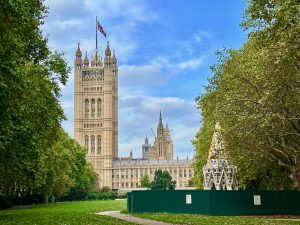
The Buxton Memorial Fountain
[picture: Simon Kershaw October 2025]
It commemorates a number of Members of Parliament
who led the 19th-century campaigns
first
to abolish the slave trade
and then
to abolish slavery itself.
And our gospel reading today
presents us with an “interesting” situation,
don’t you agree?
In that second half, Jesus talks about slaves,
and perhaps you found it a bit uncomfortable.
So, hands up if the idea of slavery
makes you uncomfortable –
the idea … of being a slave,
the idea … of owning slaves,
the idea … of trading slaves.
Slaves – that’s … other human beings.
Most of us here – with a few exceptions –
probably don’t consider ourselves
to have any direct link with slavery –
we aren’t descended from slaves,
and we probably aren’t descended
from slave-owners either,
though of course
we might still have benefitted
from institutions and investments
that derive from slavery.
I guess there are one or two exceptions among us,
and plenty of others in our town
and elsewhere around us,
and we can’t talk about slavery
without being sensitive to that
and to the impact it has had
on our friends and their families.
I’m sure that that personal stake makes a difference
to how today’s gospel reading is heard,
and speaking for myself
perhaps I find it too easy
not to worry that much about it.
Nor should we forget that there are people in this country,
probably people here in St Ives,
who are involved in “modern slavery”:
people who are exploited and kept in bondage;
people who exploit others and keep them in bondage.
Having said all that, however,
I want to make two quick points – about Jesus.
First, let’s be absolutely clear:
there is no indication at all
from anything we read in the New Testament
that Jesus or his family
or any of his immediate associates
ever owned slaves.
There are no slaves at his birth in Bethlehem,
and no slaves tending to him in the gospels.
When Jesus visits his friends Mary and Martha,
it is famously Martha
who is busy with domestic chores,
not a slave.
And the second point
is that Jesus isn’t setting out
to overturn the institution of slavery
as it existed in the ancient Mediterranean world –
not in the short term anyway.
That was for later generations –
though he clearly envisaged
a different way of treating everyone,
regardless of whether they were slave or free.
So what are we to make of all this?
Well yesterday
I was licensed by the bishop
to be a lay reader,
a licensed lay minister
in this parish.
And being a minister is also about being a servant.
You see, the word minister comes to us from Latin
and its first use was in the second century
to refer to deacons.
That’s because the word deacon
comes from the Greek word διάκονος1,
which simply means “servant”,
perhaps especially someone
who waits at table.
It wasn’t long before “minister”
came to be used of all clergy –
not just deacons, but priests and bishops too,
(even archbishops-designate)
and also of the lesser orders
such as sub-deacons and readers,
all of whom are servants …
servants of God.
And Jesus makes this point several times, doesn’t he?
In one of the weekday readings
from Morning Prayer last week,2
Jesus reminds his disciples
that the rulers of the Gentiles
lord it over them
and that the great ones of the Gentiles are tyrants.
But his disciples, Jesus says,
his disciples are to be servants;
and he mixes the language of servants and slaves
saying that
“whoever wishes to become great among you
must be your servant3,
and whoever wishes to be first among you
must be slave4 of all”.5
This same story appears also in Luke’s gospel6
only there it has an extra punchline –
“who is greater,” asks Jesus,
“the one who is at the table
or the one who serves?
Is it not,” Jesus says, “is it not the one at the table?
But I,” he answers himself, “I
am among you as one who serves”.
And there’s a version in John’s gospel too7.
There Jesus concludes
by telling the disciples
that just as he has served them,
they are to serve one another.
Just as he has served them,
they are to serve one another.
So let’s come back
to the words in today’s gospel reading:
“We are worthless slaves;
we have done only what we ought to have done!”
In our context,
in the twenty-first century,
we might well see Jesus’s words
as a little harsh,
and for some
a painful reminder
of the slave trade.
But let’s paraphrase those words a bit;
how about this?
“Our role as Christians,
as followers of Jesus and his teaching,
our role is to serve others,
to look after others,
to help others.
That’s what God asks us to do.”
We may be able to serve a lot;
or we may only have the capacity at the moment
to serve a little;
or maybe right now
we are among the ones who need to be served.
But it is this humble service to others
which is at the heart of Jesus’s message
of compassion and reconciliation.
It is the role of ordained ministers
(even of an archbishop-designate);
it is the role of licensed lay ministers;
it is the role of all of us who hear the words of Jesus.
To serve … God;
to serve … each other;
to serve … the whole of creation.
Because we stand today at a crossroads.
Of course, we stand each day at a crossroads,
the junction between the past and the future;
the past behind us,
known, or partly known;
the future before us, largely unknown.
For me, right now,
that crossroads is defined by
my licensing yesterday in the Cathedral,
my licensing as a lay minister
to serve in this parish.
But we each of us stand at a crossroads.
We don’t know what the future will bring,
individually or collectively,
for us or for our parish.
But what we do know is that
every day
Jesus calls us, each one of us,
to serve.
To serve one another,
to serve our community,
to serve the world.
So, finally once again:
“We are worthless slaves;
we have done only what we ought to have done!”
Now Jesus is prone to hyperbole.
He loves to exaggerate for effect,
to grab attention.
And we can see that here.
Sometimes we need support and affirmation.
At other times we need taking down
a peg or two.
(Well I do anyway.)
But Jesus’s message is
a call to serve.
I am, he says, among you as one who serves.
So in the days ahead
I invite you
to take a few moments to think about
what you can do to serve;
what we as followers of Jesus
individually and collectively
can do to serve:
to serve God’s world
and to serve God’s people,
to serve them here in St Ives.
Amen.
Note: at the end of this service it was announced that the Vicar would be leaving in January. Some of the “unknown future” text was written with this in mind.