calling plain courses
For some time now I have been practising ringing touches of bob doubles, and even bob minor, bob triples and bob major. I have mostly got the hang of the necessary dodges, and can start on any bell, and I can usually cope with the calls of bob, though I can only do this by remembering the sequence, or cycle of work, and not by noticing signposts such as when I cross the treble’s path (although this is occasionally obvious, especially when making 2nds’ place). And in the even-bell methods, where there is no cover bell always in last place from which to lead, I can now usually see the last bell rope go down, so that I can lead appropriately.
Tonight I got to ‘call’ various plain courses of bob doubles, bob triples and bob minor. The hard part at this stage is to know when to call the end of the method — calls should be made when the lead bell is at handstroke, a full stroke before the method ends, and where your bell is at this point depends on which bell you are ringing. Of course, harder than this is calling a touch with bobs (and singles) and getting back to rounds at the end of it; and being able to correct other ringers if they are about to go wrong. I’m definitely a long way from that. Still, progress is being made.
Now we have two of our ‘new’ ringers who can just about ring touches of plain bob doubles and triples, and we have four who can, with varying degrees of success, plain hunt to these (and other) methods. We need to get some of these other ringers to be able to ring ‘inside’ to plain bob — then we will be able to try plain courses on Sunday mornings and weddings when we are not assisted by more experienced ringers.
0 CommentsSydney Carter
Today’s Telegraph carries the obituary of Sydney Carter, best known as the writer of The Lord of the Dance — written in 1963 and described in the obituary as ‘the most celebrated religious song of the 20th century’.
Carter, who died on Saturday 13 March, was much more than the writer of this song — he was a poet, and he wrote folk songs, as well as other religious songs and hymns such as One More Step and When I Needed a Neighbour.
1 Commentbestselling artist of all time?
The BBC website reports that this accolade is claimed (by the publisher) for Annie Vallotton.
Who’s Annie Vallotton you might ask?
She is the Swiss woman who illustrated the Good News Bible in the 1970s.
Sample quote:
0 CommentsOne of the most memorable examples is of the crucifixion in Luke’s gospel. The thorn-crowned head hangs forward, below the single line of the shoulder. Above it, two right-angles are the cross.
Somehow this plain sketch conveys the desolation of Jesus far more powerfully than two hours of Mel Gibson’s blood-spattered film, The Passion of the Christ.
from the shrine of St Peter
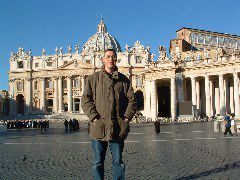 If this is Thursday, this must be the Vatican! Today we visited the Vatican Museum, the Sistine Chapel, and the Basilica of St Peter. Jonathan Boardman, chaplain of All Saints, the Anglican church in Rome, gave us a tour of some of the principal works in the museum, and talked about the paintings in the Sistine Chapel. Although I have been in the Chapel twice before, this was the first time since the major restoration of the Michelangelo frescoes. It was also the first time I had really considered the overall scheme of the decoration: the ceiling depicting scenes from the Creation to the Flood; the pairs of pictures on the side walls by a number of earlier artists (Old and New Testament scenes in pairs, where the OT scene is in some way a ‘type’ for the NT one opposite it); and, of course, the Last Judgement on the ‘east’ wall. Here we see Peter and Paul as the strong men of Christ, sporting their perfect, resurrected, bodies (or at least, as Jonathan later noted, perfect in the eyes of Michelangelo; we might not all envisage our perfected bodies as those of East German athletes!).
And then to the Basilica of St Peter. The vastness of this building never ceases to amaze. I remember visiting as a schoolboy in 1973. Our guide asked a fellow pupil to walk over to one of the columns and touch the carving of a dove that seemed a few feet off the floor. As he got nearer we realized that far from having to reach down to it, he could not in fact reach it by stretching up. The perfect scale of the building had confused our senses. On the other hand, you do have to wonder what the fisherman from the Sea of Galilee might have made of all this splendour and pomp.
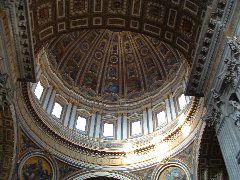 This is a place where the claims of the bishops of Rome are most evident, from the ‘Tu es Petrus’ mosaic in massive letters written around the base of the dome, to the monuments recalling papal declarations such as the ‘immaculate conception’, and above all the grandiose memorials to a swathe of popes in the main basilica. These explicitly proclaim the primacy and universal immediate jurisdiction of the see of Rome. As an Anglican, I find it very easy to challenge the show of pride and opulance, and the claims to power that these buildings and memorials present (whilst not forgetting that my own church has its own grand buildings, monuments and claims).
As a contrast to all the show it is a welcome change to descend to the crypt. Here you stand more or less at the level of the basilica built in the time of Constantine in the first half of the fourth century. Immediately beneath the dome and the high altar (with its great baldachino designed by Bernini, and forged from bronze taken from the Pantheon of ancient Rome) stands the tomb of St Peter. Not his actual tomb, I think, which lies another level down, not accessible to the general public, but a shrine to the saint, nonetheless. This is the place to stand and give thanks for the life of Simon son of Jonah, to whom Christ gave the nickname ‘Cephas’ or ‘rock’ (‘petros’ in Greek), and to pray — especially at this time, in the middle of the Week of Prayer for Christian Unity — for the unity of the Church, union amongst Anglicans and union with our other separated brothers and sisters, and especially in this place, union with the see of Rome, with the successors of St Peter.
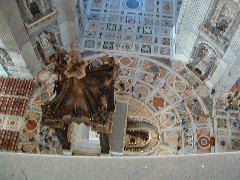 When you stand before, or over, the tomb of the leader of the Apostles, you are taken back to New Testament times, to the days 2000 years ago when Jesus walked beside the Sea of Galilee and called Simon, son of Jonah, to follow him, to the days when Simon Peter acclaimed Jesus as the Messiah, the Christ, disowned him, and was forgiven, to the days when he preached the resurrection of Christ in Jerusalem, and then through the eastern Roman Empire, before ending up in Rome, to suffer and die as a witness to the kingdom of God proclaimed by the Jesus he had known. Here, in the crypt of the basilica, the pomp of the main church is forgotten — the roof is low, the walls are plain. Here are the simple tombs of many of the popes, placed close to where they believed Peter was buried. Here it is possible to forget the grandeur that is just a few feet over your head, and to recover a simple spirituality, and the simple message at the heart of what Christians believe, and to which Christians down the ages have borne witness.
It is easy to say that the claims of Rome are misconceived and misunderstood, but even so I find myself not unwilling to allow a primacy of honour to this ancient see, effectively the only one remaining of the ancient patriarchates of Jerusalem (the see of James, the brother of Jesus), of Alexandria, and of Antioch, all three long since having lost their Christian hinterland. This primacy would not be the primacy of the main basilica, a primacy of marble and costly show, a primacy of universal jurisdiction or of infallible pronouncements; rather it would be like the crypt, plain and simple, unadorned, the servant of all, exhibiting moral strength, uncorrupted personal character, and the love of God the Father and of the created world, preached by the carpenter of Nazareth.
0 Commentson the feast of St Agnes
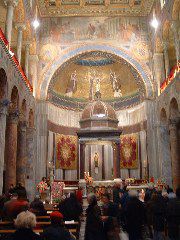 Today we visited the church of Sant’Agnese fuori le Mura — St Agnes outside the Walls. It’s the feast day of St Agnes, a young girl of 12 or 13, who was killed in Rome for her Christian faith near the end of the persecution under the Emperor Diocletian, around the year 304. This is the church where she is buried, and a great service is held in this church on this her feast day.
At the start, two tiny (live) lambs, garlanded and bedecked with flowers are carried into the church on trays and placed on the altar. They are blessed, and then, during the Gloria, carried out in procession, and away to a convent. When they are old enough to be shorn, their wool is woven into the palliums which the Pope gives to all Roman Catholic Archbishops (as a symbol of their metropolitan jurisdiction).
 Margaret Visser has written an interesting book about this church and the cult of St Agnes, The Geometry of Love (see it at Amazon UK, and there are some pictures on her website). After the service one of our group spotted Margaret Visser in the church and she was kind enough to come and talk to us about the church and the book.
Here we worshipped; here we prayed, at this place (as Eliot wrote about Little Gidding) where prayer has been valid; to stand and pray at the shrine of this young girl, martyred for her faith 1700 years ago today; to stand and pray with this young girl and for this young girl, who surrendered her life rather than offer incense and prayers to pagan gods; to stand and pray with the countless numbers who down the centuries have stood in this same place, before the tomb-chest of Agnes, and who have similarly offered their prayers — this is a moving experience, although one rather wonders what she would have made of the great church and the great service held in her name, let alone the incense offered at the altar over her tomb!
0 CommentsUnity, Rome and all that
Today the Week of Prayer for Christian Unity begins. In some Anglican calendars (though not in England) this date, 18 January, would normally be the feast of the Confession of St Peter. The Week of Prayer ends next Sunday, 25 January, a date kept as the feast of the Conversion of St Paul.
The Confession of Peter is kept on a date observed in the calendar of the Roman Catholic Church as ‘the Chair of Peter’, which commemorates the arrival of Peter in Rome, the date from which Roman Catholics account him as the first Bishop of Rome, the first Pope (the ‘Chair’ is the cathedra, or chair from which a bishop teaches in their cathedral church — the traditional Chair of St Peter is enshrined in a magnificent baroque monument by Bernini at the west end of St Peter’s Basilica in the Vatican). This feast has been commemorated in Rome from the earliest times, and the gospel reading for the day is traditionally the acclamation by Peter of Jesus as the Messiah, the Son of the living God (Matthew 16.16). It is this confession of faith which gives its name to the feast as commemorated by some Anglicans.
The Conversion of Paul, of course, commemorates the event described in the Acts of the Apostles (Acts 9.1–9), where Paul, journeying to Damascus to persecute the early Christians, is waylaid by a blinding light, and called to serve Christ, whom he has been persecuting.
These two days, the Confession of Peter and the Conversion of Paul, bracket the Week of Prayer for Christian Unity. As Paul’s conversion reminds us that we are united in a call to proclaim Jesus among the nations, so Peter’s confession reminds us that we are united in proclaiming the inspired knowledge of Jesus Christ ‘the Son of the living God’.
During the Week of Prayer I shall be spending some time in Rome. I hope to be able to pray at the tomb of St Peter, and to visit also the basilica of St Paul. Here are some of the ancient memorials of the Christian faith. I hope also to be present at an audience with the Pope, the Bishop of Rome. Even though Anglicans are not in communion with the See of Rome, it is that unity — along with unity with our other separated brothers and sisters — for which we pray most especially next week.
As Anglicans, we have long considered ourselves to represent the Via Media. Historically this has meant the ‘middle way’ between the ‘extremes’ of Geneva and Rome, between extreme Protestantism and extreme papalism. Over the last hundred years or so it has perhaps been expressed in the Lambeth Quadrilateral, emphasising our gathering around the fourfold points of the bible (as containing all things necessary to salvation), the sacraments of baptism and the eucharist, the liturgy of the Book of Common Prayer, and government by bishops, suitably adapted to different places. We have, perhaps, seen ourselves as a possible model of unity without uniformity, a communion of self-governing Churches, not beholden to one another, nor governed by one another, each expressing the essentials of the Christian faith in its own area. Each Church too has provided ways in which the bishop of a diocese can take counsel with representatives of all their people, laity and clergy alike. This was an important part of the English Reformation, led by the bishops and enacted by the people in Parliament, and it was a principle further developed by the American Church, and then in synodical government in New Zealand and elsewhere. All these have been important contributions by Anglicans to our understanding of the Church — both of our own Church and as a vision of a wider, united Church. Unity not uniformity.
In our time we seem to be straining at the bonds of unity which tie us to each other, to our bishops and to the Archbishop of Canterbury. In this Week of Prayer for Christian Unity let us not forget to pray for all our fellow Anglicans — that our communion may not be fragmented — as well as for reunion with those with whom we are not currently in communion.
May we all be one, that the world may believe.
0 CommentsBr Michael SSF
Last Friday, the death was announced of Br Michael SSF. In his retirement he had been an assistant bishop n the diocese of Ely, and I had seen him regularly at diocesan synods and at confirmation services, including one in St Ives, pre-1994. When he had first joined the Society of St Francis, he became the secretary to the Order’s ‘Father Guardian’, Fr Algy Robertson. Fr Algy had been the vicar of St Ives before being one of the founders of the SSF, and with the death of Br Michael another link with that time is gone.
Obituaries have appeared in the national press: the Daily Telegraph on Monday.
The requiem and funeral will be at St Bene’t’s Church in Cambridge on Monday 15 December.
May he rest in peace!
0 Commentsmartyrdom in the Solomon Islands
ACNS reports that the funerals have taken place of the seven members of the Melanesian Brotherhood who met their deaths earlier this year in Guadalcanal (see reports here and here).
Post mortems indicate that Brother Nathaniel Sado was tortured and died from the wounds inflicted over several days. Of the six Brothers who went to investigate his disappearance, three were shot and killed upon arrival, and the other three were beaten and tortured and then shot the next day.
The report describes the funeral of Br Robin Lindsay, attended by the families of the murdered Brothers, as well as the Governor General, the Prime Minister, and also the Archbishop and hundreds of others.
May they rest in peace!
0 Commentsbobbing along
After a few more weeks practising ringing the no 2 bell at Bob Doubles, I have for the last couple of Mondays been trying to ring a different bell. Tonight I was ringing the number 5 bell, which has the advantage of only having to look one way (except when leading off the tenor cover). Then after a couple of plain courses a bob was called, and I had to cope with this alteration to the pattern. First time was easy, because I knew what to do — instead of making 2nd’s place, continue plain hunting up to the back, down to the front, and make 2nd’s next time. Then a bob was called when I was dodging 3/4 up, and I was lost completely. Apparently I should have made 4th’s, then plain hunted back to the lead and dodged 3/4 up next time. I’ll have to check this — I fancy I might get asked to do something similar on Wednesday! [Correction: after making 4th’s, I should have hunted down to the lead, and next time lain four blows in 5th place; that is, by making 4th’s place you become the bell that is dodging 3/4 down, and that bell’s next variation from plain hunting is four blows at the back. Got that?]
In other bellringing news, our captain has indicated his intention to stand down, which means I get to be captain. Gulp.
[Update: at a ringers’ meeting held before practice on 8 December, I was elected tower captain, and Chris Armes as new vice-captain.]
0 CommentsThe Great Schism
This morning I listened to another programme in the BBC Radio 4 series, In Our Time. This must be the best programme on the radio, and this week it looked at the Great Schism between the eastern and western Church, concentrated in the mutual excommunication in 1054.
What is even more remarkable is the relevance of much of what they were talking about to the current goings-on at Lambeth. Here we had a dispute primarily about authority, and about a shift in the balance of power, from the ‘old church’ in the Greek-speaking east, towards the Latin-speaking west, culiminating a determination by the up-and-coming west and its patriarch at Rome to concentrate authority in its hands, rather than sharing it in a more democratic ‘first among equals’ basis.
My only caveat would be to wonder about the authority of an ‘expert’ who thinks that communion in one kind, increasingly practised in the West, meant that the laity were limited to receiving only the chalice, and not the bread — a statement which no one corrected.
Anyway, the broadcast is worth listening to, whether or not you see any parallels, or whether you agree with my suggested parallels (perhaps it’s like a good sermon, which every listener thinks is directed solely at them). Then, if you haven’t done so before, enjoy youself browsing through the archives listening to previous broadcasts over the last couple of years.
0 Comments