Civic Sunday 20 September 2026
Sermon preached at the Civic Service at St Ives, before the Deputy Lieutenant, the High Sheriff, the Vice-Chairs of Cambridgeshire County Council and Huntingdonshire District Council, the Mayor of Peterborough and other neighbouring towns, and the Town Mayor and Council of St Ives, together with a detachment from 42 Engineer Regiment (Geographic), and youth organizations.
Readings: Micah 6.6–8; Matthew 22.16–21
Here’s a question to start a sermon –
why are we here?
Don’t worry,
I’m not asking one of those great existential questions –
“what is the meaning of life?”
Or “are you saved?”
No, I mean it much more literally.
Are you here because you were invited?
Or – did your commanding officer tell you to come?
Maybe your parents said you had to go
and brought you to the Cattle Market car park.
Well, of course, the real reason we’re here
is for Civic Sunday,
when our Town Mayor and Council
come ceremonially to church,
as they have for hundreds of years;
an opportunity to give thanks,
and celebrate all the good things about our town.
And people come to this church for all sorts of reasons.
Last weekend, for example, was the Heritage Open Days,
and several hundred people came here
to explore the architecture,
and the vestments that were on display.
Among the prominent features that people stop and look at
is the big colourful stained-glass window
at the end of the south aisle –
over there, to your right.
It’s not the best window in the church,
but I reckon it’s far from the worst either!
You may not be able to see it properly from your seat,
but if you get a chance later do have a closer look,
or perhaps come back another time.
And there’s a picture of it
on the back of our order of service,
so you might like to have that before you.
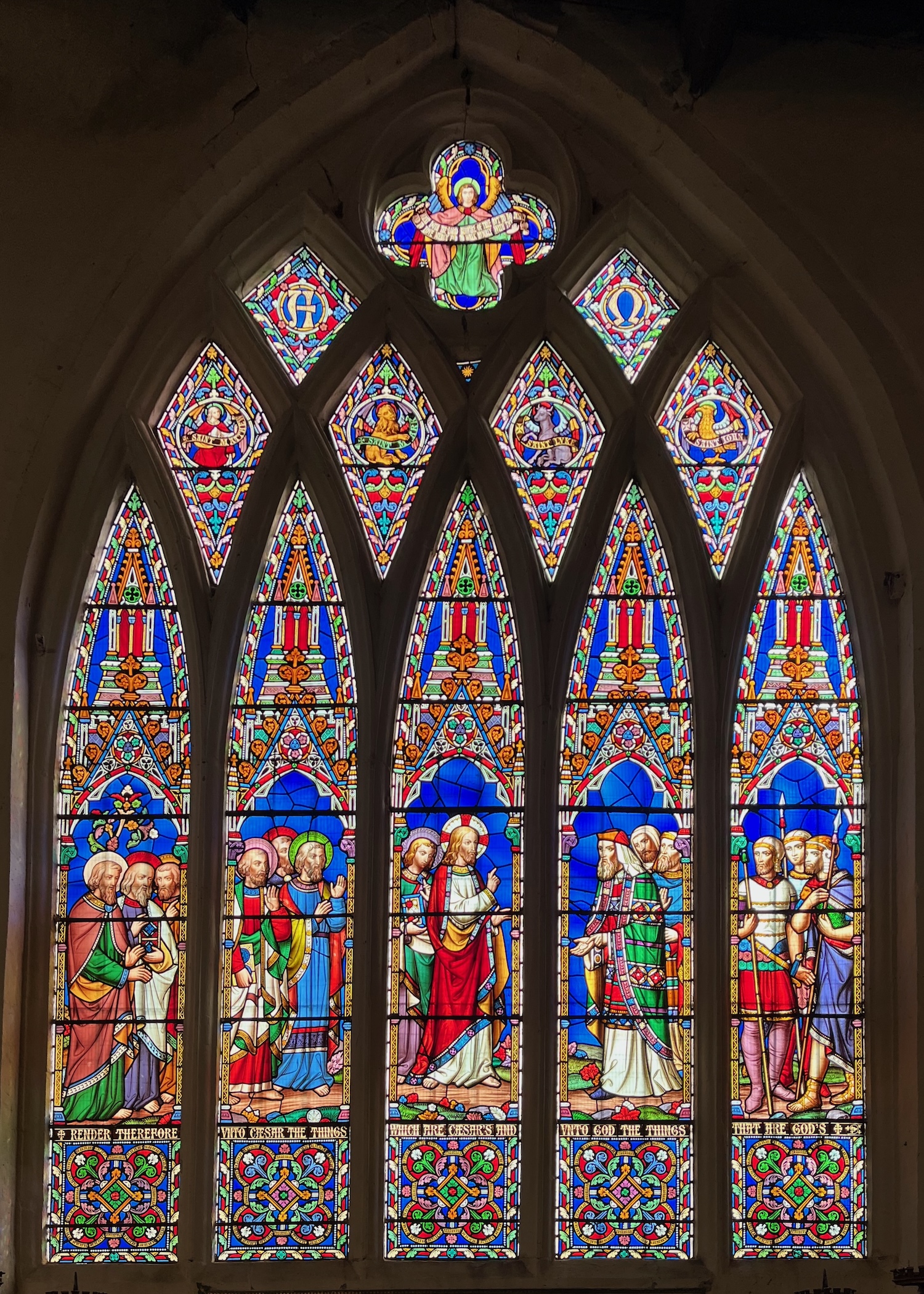
It’s a typical colourful Victorian window.
There’s Jesus in the middle,
wrapped in a red cloak.
Over to the left are his disciples,
perhaps cowering a bit behind their leader.
And on the other side there’s a group of people
clearly in discussion with Jesus.
The one at the front,
wearing a green cloak,
is pointing to something in his right hand.
It’s a small coin.
And underneath
in small lettering
that you perhaps can’t read without your glasses on
is an inscription beginning
“Render therefore unto Caesar”.
I hope you might recognise these
as words that we just heard read by our Town Mayor.
That’s the story that this window depicts.
So – what’s going on?
Well, in Jesus’s time
if you wanted to worship at the temple
you needed special temple money,
not ordinary everyday Roman coins.
But what Jesus’s questioners produce
is an ordinary Roman coin, a denarius.
They’d been trying to trap Jesus:
they wanted him to say that a religious person
didn’t have to follow the rules of the state.
And Jesus replies that they
– and we –
all have to do what the Emperor Caesar requires,
what the state requires.
But,
and this is the important bit,
Jesus says we should also do what God requires as well.
So what is it that God requires of us?
What does God want us to do?
And that[s where our first reading comes in.
The prophet Micah lived
some 700 years earlier than Jesus –
so getting on for 3000 years ago.
And maybe you think
that someone who lived nearly 3000 years ago
hasn’t got much to say to us in the 21st century.
So let me remind you what Micah said.
He says that God
doesn’t really care about temple sacrifices,
or about religious ritual generally.
You might think
that’s a strange thing for a preacher to say:
that God doesn’t care about religious ritual.
This ancient Jewish prophet says
that what God cares about is –
to do justice,
to love mercy,
and to walk humbly with God.
These are rules that go to the heart
of Jewish-Christian morality and ethics.
The morality and ethics that form the basis of our society.
And we can tease this out a little more;
tease it out into two basic themes
that can guide each of us in our lives.
The first of these themes is:
compassion.
So, compassion is about seeing things
from the other person’s point of view.
It’s about having sympathy and empathy –
sympathy and empathy with people who are suffering;
sympathy and empathy with people we know –
and with people we don’t know.
It might mean going out of our way
to help a person or group different from us,
or who we don’t even like,
or who perhaps don’t like us.
That might be … members of a lifeboat crew
risking their lives
to rescue people trying to cross the sea.
It might mean soldiers risking their lives
to keep the peace between warring parties,
or defend those at risk.
Or it might mean …
sitting and listening
to a person who just needs someone to talk to.
I’m sure you can think of other examples.
And the second of my two guiding themes
is … reconciliation.
Reconciliation.
This is about not holding grudges for slights and wrongs –
whether real or imagined.
Reconciliation is about saying “sorry”,
it’s about
not waiting for the other person to say “sorry” first –
or maybe even at all.
Even if they don’t, even if it’s their fault,
we can still work for that reconciliation.
Reconciliation stops hate from eating away at our lives,
it stops hate and conflict spreading,
and it lets people and groups
overcome past issues, past conflicts –
in our personal lives and between larger groups.
Now maybe you’re thinking that this all sounds very well.
Compassion and Reconciliation – lovely ideas,
but it isn’t always easy to carry them out, is it?
Because it takes practice and awareness.
We have to practise compassion and reconciliation
so that they become ingrained in us.
We have to practise them
in the small ordinary everyday things
so that if we are called upon
to exercise them in something important
they have become our natural way of doing things.
And this is the message for all of us.
It’s the message for young people
setting out on life’s journey.
It’s the message for soldiers on the battlefield –
or guiding others on the battlefield.
It’s the message for politicians –
Mayors and Councillors at all levels of local government,
and for national and international politicians too.
For all of us here.
Compassion and Reconciliation.
If we equip ourselves with these two
then we shall be doing justly and loving mercy,
and we shall be giving to God the things that are God’s.
Finally, then, let’s return to that window over there.
We’ve seen that it shows Jesus
reminding us to give to God the things that are God’s.
So now let your gaze wander upwards,
above the coloured canopies in the middle of the window
right to the top.
And in that top light is an angel,
an angel with rainbow-coloured wings,
holding a scroll.
And what do you think is written on that scroll?
It says …
“do justly, love mercy, walk humbly with thy God”.
It’s the key verse from our other reading.
So I invite you
to take away this service leaflet
when you leave the church.
Stuff it in your pocket.
And later, when you get home,
take it out and look at the picture,
and recall these two bible verses:
“Give to Caesar the things that are Caesar’s
and to God the things that are God’s”;
and
“What does God require?
Do justly, love mercy, walk humbly”.
And then – practise compassion and reconciliation,
practise them in the little things of life,
make them your core values,
and together we will make our town
and the world around us
a better place for ourselves,
for our children,
for everyone.
Amen.
(1248 words)
0 CommentsAsh Wednesday: 18 February 2026
Readings: Isaiah 58.1–12; Psalm 51.1–18; Corinthians 5.20b – 6.10; Matthew 6.1–6, 16–21.
In the name of the Father and of the Son and of the Holy Spirit. Amen.
So are you giving something up for Lent?
It’s an old tradition isn’t it?
As small children we talked about giving up chocolate –
but to be honest we never had a lot of chocolate,
so there wasn’t much to give up!
And as an adult I have tried eating a bit less,
with limited success;
and I know a number of people
who refrain – or try to refrain –
from alcohol during Lent.
Of course all these things,
we are told,
are good for our health.
But Lent isn’t really about our health,
not our physical health anyway.
It’s not a sort of “dry January” for Christians.
So what is Lent for,
and what does Ash Wednesday mean?
Our service booklet tells us a little about the history –
that Lent perhaps originated
as a period of instruction
for those who were to be baptized at Easter.
It seems possible
– and we don’t really know –
it seems possible
that Easter was originally not always on a Sunday
but could fall on any day of the week.
And the day before Easter,
the eve of Easter, whatever day of the week it was,
was kept as an extra day of fasting.
But eventually the annual Easter
was fixed to the weekly celebration
of the resurrection each Sunday.
The fast before it was gradually extended,
becoming forty days
under the influence of the gospel account
of Jesus’s fast and temptation after his baptism,
a story we will hear next Sunday.
Now in a little while
we will all be invited
to begin Lent
by being marked with an ashen cross on our forehead.
And yet we have just heard
what Jesus has to say on the topic of fasting.
Let me read those words to you again …
whenever you fast, do not look dismal,
like the hypocrites,
for they disfigure their faces
so as to show others that they are fasting.
Truly I tell you, they have received their reward.
But when you fast,
put oil on your head and wash your face,
so that your fasting may be seen not by others
but by your Father who is in secret
“Put oil on your head and wash your face”
Jesus tells us –
and oil here is both a soap and a perfume,
cleansing and giving a pleasant fragrance.
Jesus, it seems to me,
doesn’t want us to parade our faith,
or at least, not this aspect of our faith.
What are we to make of this?
Well, first we should remember
that Jesus is a master of public speaking,
of oratory or rhetoric.
And one of his favourite rhetorical devices
is hyperbole – the art of exaggeration.
Jesus just seems to love to exaggerate for effect.
And we see that clearly
in the first part of today’s gospel reading.
Remember the bit where Jesus talked about
not letting “your left hand
know what your right hand is doing”?!
So we should always take into account
that Jesus is speaking
to a particular group of people
in a particular time and place,
and we cannot tell if he had a grin on his face
or the way in which he told a story.
And let’s also look for a moment
at our first reading this evening,
from the prophet Isaiah.
Perhaps it can give us a bit of a clue as well.
Here are a couple of verses
from the middle of that reading,
verses 6 and 7 from Isaiah chapter 58
Is not this the fast that I choose:
to loose the bonds of injustice,
to undo the thongs of the yoke,
to let the oppressed go free,
and to break every yoke?
Is it not to share your bread with the hungry,
and bring the homeless poor into your house;
when you see the naked, to cover them,
and not to hide yourself from your own kin?
That really does give it to us pretty straight, doesn’t it?
Isaiah tells us
that the sort of fasting God wants
is to help those
who are caught up
in the injustice and unfairness of this world.
The hungry and homeless,
those without a stitch to their name.
And then there’s that bit at the end
about not hiding yourself from your own kin –
what on earth is that about?
It’s not, I think,
about ignoring the phone
when a relative you don’t want to speak to telephones.
Rather it refers to the system of obligations
that Israelite society placed on family members
to support each other in hard times.
Don’t find excuses,
God says through Isaiah,
don’t make excuses not to help them.
Well, Isaiah is not alone among the prophets in proclaiming
that this is what God wants the people of Israel to do.
And we see the same theme
carried directly through into Jesus’s ministry –
one reason why he was described
by his contemporaries
as a prophet.
For example,
we read in Luke’s gospel
the story of Jesus coming to Nazareth
at the start of his ministry
and reading the passage where Isaiah says
“[God] has anointed me
to bring good news to the poor,
release to the captives,
recovery of sight to the blind,
to let the oppressed go free.”
And now we can see
the hypocrisy that Jesus refers to.
Jesus warns each one of us against hypocrisy –
the hypocrisy of making it look
as if we are being pious and holy,
but not actually doing
the things that Jesus
(along with the prophets)
reminds us that we should be doing.
So let us use these coming weeks of Lent
to review our daily life
and our Christian discipleship.
It’s not about giving up chocolate or going on a diet –
well maybe we should do those things anyway
and try and live more healthily,
more ethically and more responsibly.
But more than that
it is an opportunity for each one of us,
you and me,
to review our response
to the good news that Jesus proclaims,
the good news
that all of us are made in God’s image
and all of us are loved by God.
All of us –
not just you and me,
but all people across the world,
those we know and those we don’t know,
those we like and even those we don’t like,
whether individually or as groups.
All are made in God’s image
and are loved by God.
And our response to that
must be
to work for
the loosening of the bonds of injustice,
to work for
the care of the poor and hungry and the oppressed,
that those people too
may live lives made in the image of God
and the love of God.
May you have a holy and blessed Lent!
1 CommentThe Baptism of Christ: 11 January 2026
Readings: Isaiah 42.1–9; Psalm 29; Acts 10.34–43; Matthew 3.13–end.
Words from today’s gospel reading:
“Jesus came from Galilee
to John at the Jordan,
to be baptized by him.”
In the name of the Father and of the Son and of the Holy Spirit. Amen.
When I was a bit younger,
we used to hear from time to time
about Billy Graham.
I’m sure many of you remember him too.
And for anyone who doesn’t,
he was a renowned American evangelist
from the 1950s through to the 90s.
And every few years
he would come to the UK
and hold rallies
in big arenas and stadiums,
and in the later years
technology meant
these could be simultaneously relayed
to smaller, local venues.
Perhaps you know someone
who attended one of these rallies –
maybe you even went to one yourself.
And Billy Graham
stood in a long line of “revivalist” meetings,
encouraging the young –
and the not so young –
to commit their lives to God.
There was a big revival
at the start of the 20th century,
largely in the USA,
which became the Pentecostal movement.
And a century earlier
revivalism had swept through
the villages and communities of Wales,
leading to a multiplicity of nonconformist chapels
throughout the country.
And we can look further back
to Methodism in the early 18th century
and back before that to earlier revivals.
And I wonder whether we can see
the ministry of John the Baptist in this same light.
There he stands
on the banks and in the shallows
of the River Jordan,
(the arena of his day perhaps?)
and the crowds come out
to hear him preach.
“All Jerusalem”, we are told.
And then instead of an “altar call”,
those who had heard his message
and wanted to be part of it
were dunked in the river water
as a sign that their sin was washed away
and they were beginning afresh.
John’s message
was that people needed to repent
and live a godly life
because judgement was coming,
indeed it would arrive,
he seems to have thought,
very soon.
And into this revivalist meeting comes … Jesus.
Now I want to make three points this morning,
and the first of these points is about – Jesus.
Because the presence of Jesus
here
with John the Baptist
gives the gospel writers
some pause for thought.
You see,
baptism was a sign
of repentance for sins committed,
and yet …
and yet
we believe Jesus was without sin.
So why was Jesus baptized?
In this morning’s reading
we can see
a bit of the struggle with this question.
In Matthew’s account
we heard Jesus and John
debating the issue –
and we can easily imagine
that these are the sort of arguments
that must have been debated
in the early years of the Christian Church.
But we also have to take into account
what is reported after the baptism.
Matthew tells us that
“just as [Jesus] came up from the water,
suddenly the heavens were opened to him
and he saw the Spirit of God
descending like a dove and alighting on him.“And a voice from heaven said,
‘This is my Son, the Beloved,
with whom I am well pleased.’ ”
If we read carefully,
we see that Matthew tells us
that it was Jesus himself
who saw the heavens open.
If we were to put this
in the language we would use about anyone else,
we might perhaps say
that this was a profound religious experience.
It had (as the theologian Joe Cassidy wrote)
“all the hallmarks of a powerful conversion experience,
a real turning-point”.
It was the moment when,
perhaps with hindsight,
Jesus recognised God’s special call to him,
the special relationship of a son to his father.
If indeed things happened something like this,
then Jesus must have subsequently
told others of his experience –
how he had been affirmed
in the ministry he was about to undertake –
that ministry
as a wandering preacher and teacher and healer
that would ultimately lead to Jerusalem
and to the Cross.
And for my part
I find the humanity of Jesus
profoundly meaningful.
But each of you
will have to come to your own conclusions
about how plausible this is.
And the second thing I want to say is about – us.
We too – nearly all of us here I imagine –
have been baptized.
For many of us
that happened when we were tiny infants.
It’s an event we are unable to remember.
For others,
being baptized was a deliberate decision
we made when we were older.
(And maybe – one or two of you
have not yet been baptized,
or perhaps you are considering being baptized.)
Well, today is an opportunity for us
to think about baptism,
to think about our own baptism
(or perhaps to think about
the possibility of our own baptism).
So one of the things
today’s gospel reading tells us
is that baptism is something
we share with Jesus.
In baptism we are incorporated into Jesus;
incorporated with Jesus
into the life of the Christian Church –
all those people who down the ages
have tried to follow the teaching of Jesus.
All those people who in our own time,
and in our own lives,
have tried to follow the teaching of Jesus.
Now in a few moments
we will take some time
to remember our own baptisms.
The water of baptism is life-giving
and brings refreshment.
But we shall also remember
that we don’t always live up to the promises we made
(or that were made on our behalf)
at our baptisms.
And yet the water of baptism
washes away our wrong-doings.
Through the water of baptism we are,
as I said, united with Jesus.
Through the water of baptism
we are given life –
new life in God’s kingdom,
new life where we are called
to share God’s love with the world:
sharing our food with the hungry,
and our houses with the homeless,
sharing our hope with those who are in despair,
sharing forgiveness and reconciliation
with those who have wronged us.
This is the life that our baptism inaugurates us
– each one of us – into.
And that brings me to my third point, my final point.
The story we have heard today
about Jesus’s baptism
marks the start of the story
of the adult Jesus.
Yes, we have heard over the last few weeks
the story of Jesus’s birth and the coming of the Magi,
and those passages form
a sort of prologue or prequel
to the rest of Matthew’s gospel.
But today’s reading is where the action starts.
It begins with the crowds
coming to see John the Baptist:
they hear him and many of them are baptized.
That is how the gospel,
the good news about Jesus,
begins,
with John baptizing and making disciples.
Now baptism is not mentioned again in the gospel.
Not until the very end.
We have to turn
to the very last three verses
of Matthew’s gospel,
and there we find that it ends
with a passage that has some parallels
with this beginning.
At the end of Matthew’s gospel,
Jesus tells his followers
to go out …
and preach to the whole world
and to baptize all people,
to teach everyone about God’s love.
And that is our mission.
To give people
the opportunity to hear the good news of Jesus,
the good news of the kingdom of God
where those in need are blessed.
That is our mission.
To give people the opportunity
to have a religious experience
and to turn their lives around.
We ourselves always need to be open to this,
and we ourselves can sometimes be
the person who helps someone else
– a family member, a neighbour, even a stranger –
to come to that moment in their own life.
And when we do this
we are strengthened by the promise
with which Matthew ends his book:
“Remember,”
Jesus said,
“I am with you always, to the end of the age.”
[pause]
“This is my Son, the Beloved, with whom I am well pleased.”
0 Comments