Civic Sunday 20 September 2026
Sermon preached at the Civic Service at St Ives, before the Deputy Lieutenant, the High Sheriff, the Vice-Chairs of Cambridgeshire County Council and Huntingdonshire District Council, the Mayor of Peterborough and other neighbouring towns, and the Town Mayor and Council of St Ives, together with a detachment from 42 Engineer Regiment (Geographic), and youth organizations.
Readings: Micah 6.6–8; Matthew 22.16–21
Here’s a question to start a sermon –
why are we here?
Don’t worry,
I’m not asking one of those great existential questions –
“what is the meaning of life?”
Or “are you saved?”
No, I mean it much more literally.
Are you here because you were invited?
Or – did your commanding officer tell you to come?
Maybe your parents said you had to go
and brought you to the Cattle Market car park.
Well, of course, the real reason we’re here
is for Civic Sunday,
when our Town Mayor and Council
come ceremonially to church,
as they have for hundreds of years;
an opportunity to give thanks,
and celebrate all the good things about our town.
And people come to this church for all sorts of reasons.
Last weekend, for example, was the Heritage Open Days,
and several hundred people came here
to explore the architecture,
and the vestments that were on display.
Among the prominent features that people stop and look at
is the big colourful stained-glass window
at the end of the south aisle –
over there, to your right.
It’s not the best window in the church,
but I reckon it’s far from the worst either!
You may not be able to see it properly from your seat,
but if you get a chance later do have a closer look,
or perhaps come back another time.
And there’s a picture of it
on the back of our order of service,
so you might like to have that before you.
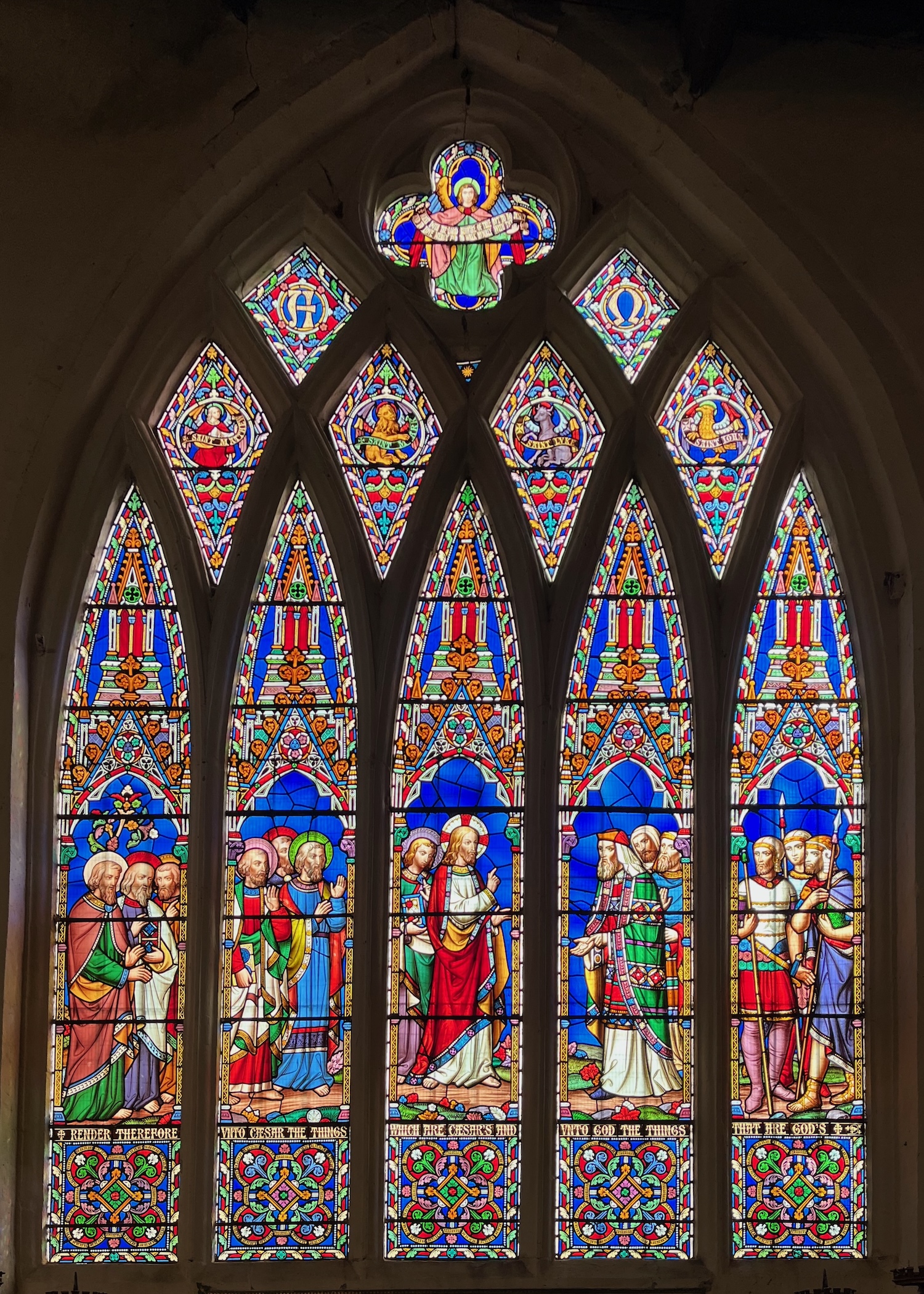
It’s a typical colourful Victorian window.
There’s Jesus in the middle,
wrapped in a red cloak.
Over to the left are his disciples,
perhaps cowering a bit behind their leader.
And on the other side there’s a group of people
clearly in discussion with Jesus.
The one at the front,
wearing a green cloak,
is pointing to something in his right hand.
It’s a small coin.
And underneath
in small lettering
that you perhaps can’t read without your glasses on
is an inscription beginning
“Render therefore unto Caesar”.
I hope you might recognise these
as words that we just heard read by our Town Mayor.
That’s the story that this window depicts.
So – what’s going on?
Well, in Jesus’s time
if you wanted to worship at the temple
you needed special temple money,
not ordinary everyday Roman coins.
But what Jesus’s questioners produce
is an ordinary Roman coin, a denarius.
They’d been trying to trap Jesus:
they wanted him to say that a religious person
didn’t have to follow the rules of the state.
And Jesus replies that they
– and we –
all have to do what the Emperor Caesar requires,
what the state requires.
But,
and this is the important bit,
Jesus says we should also do what God requires as well.
So what is it that God requires of us?
What does God want us to do?
And that[s where our first reading comes in.
The prophet Micah lived
some 700 years earlier than Jesus –
so getting on for 3000 years ago.
And maybe you think
that someone who lived nearly 3000 years ago
hasn’t got much to say to us in the 21st century.
So let me remind you what Micah said.
He says that God
doesn’t really care about temple sacrifices,
or about religious ritual generally.
You might think
that’s a strange thing for a preacher to say:
that God doesn’t care about religious ritual.
This ancient Jewish prophet says
that what God cares about is –
to do justice,
to love mercy,
and to walk humbly with God.
These are rules that go to the heart
of Jewish-Christian morality and ethics.
The morality and ethics that form the basis of our society.
And we can tease this out a little more;
tease it out into two basic themes
that can guide each of us in our lives.
The first of these themes is:
compassion.
So, compassion is about seeing things
from the other person’s point of view.
It’s about having sympathy and empathy –
sympathy and empathy with people who are suffering;
sympathy and empathy with people we know –
and with people we don’t know.
It might mean going out of our way
to help a person or group different from us,
or who we don’t even like,
or who perhaps don’t like us.
That might be … members of a lifeboat crew
risking their lives
to rescue people trying to cross the sea.
It might mean soldiers risking their lives
to keep the peace between warring parties,
or defend those at risk.
Or it might mean …
sitting and listening
to a person who just needs someone to talk to.
I’m sure you can think of other examples.
And the second of my two guiding themes
is … reconciliation.
Reconciliation.
This is about not holding grudges for slights and wrongs –
whether real or imagined.
Reconciliation is about saying “sorry”,
it’s about
not waiting for the other person to say “sorry” first –
or maybe even at all.
Even if they don’t, even if it’s their fault,
we can still work for that reconciliation.
Reconciliation stops hate from eating away at our lives,
it stops hate and conflict spreading,
and it lets people and groups
overcome past issues, past conflicts –
in our personal lives and between larger groups.
Now maybe you’re thinking that this all sounds very well.
Compassion and Reconciliation – lovely ideas,
but it isn’t always easy to carry them out, is it?
Because it takes practice and awareness.
We have to practise compassion and reconciliation
so that they become ingrained in us.
We have to practise them
in the small ordinary everyday things
so that if we are called upon
to exercise them in something important
they have become our natural way of doing things.
And this is the message for all of us.
It’s the message for young people
setting out on life’s journey.
It’s the message for soldiers on the battlefield –
or guiding others on the battlefield.
It’s the message for politicians –
Mayors and Councillors at all levels of local government,
and for national and international politicians too.
For all of us here.
Compassion and Reconciliation.
If we equip ourselves with these two
then we shall be doing justly and loving mercy,
and we shall be giving to God the things that are God’s.
Finally, then, let’s return to that window over there.
We’ve seen that it shows Jesus
reminding us to give to God the things that are God’s.
So now let your gaze wander upwards,
above the coloured canopies in the middle of the window
right to the top.
And in that top light is an angel,
an angel with rainbow-coloured wings,
holding a scroll.
And what do you think is written on that scroll?
It says …
“do justly, love mercy, walk humbly with thy God”.
It’s the key verse from our other reading.
So I invite you
to take away this service leaflet
when you leave the church.
Stuff it in your pocket.
And later, when you get home,
take it out and look at the picture,
and recall these two bible verses:
“Give to Caesar the things that are Caesar’s
and to God the things that are God’s”;
and
“What does God require?
Do justly, love mercy, walk humbly”.
And then – practise compassion and reconciliation,
practise them in the little things of life,
make them your core values,
and together we will make our town
and the world around us
a better place for ourselves,
for our children,
for everyone.
Amen.
(1248 words)
0 Comments