Trinity 7: 14 July 2024
Readings: 2 Samuel 6.1–5, 12b-19; Psalm 24; Ephesians 1.3–14; Mark 6.14–29
May the words of my mouth and the meditation of my heart be acceptable in your sight, O Lord.
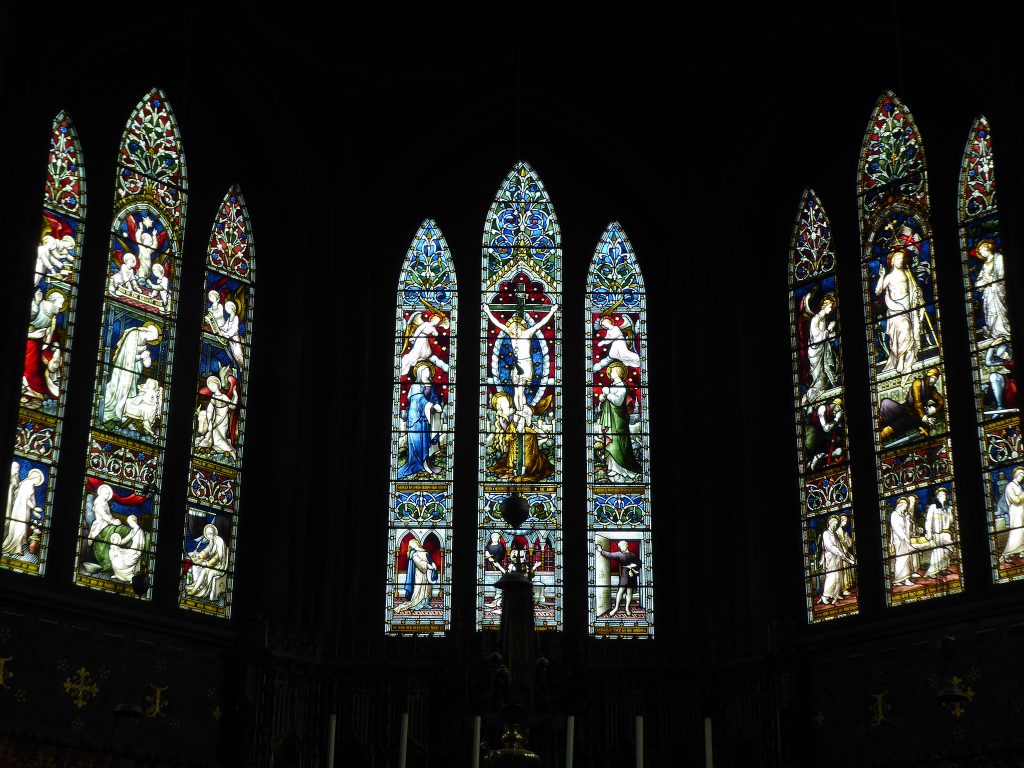
(The east windows at St John the Baptist Church, Leamington Spa; photo by Aidan McRae Thomson)
When I came to prepare this sermon, two themes stood out.
First, John the Baptist and my “relationship” with him.
I’ll come back to that in a moment.
The other theme from our readings is …
Well … it’s dancing!
David dancing before the Ark;
Salome dancing before Herod.
Now it’s a bit of a co-incidence
that they are paired here together:
we’ve been hearing the story of David
over the last few weeks,
and we just happen to arrive at this episode
as the gospel gets to this interlude in Jesus’s ministry.
But I expect lots of you watch tv programmes about dancing –
Strictly Come Dancing anyone?
So perhaps you’re imagining David and Salome
as celebrity contestants in Strictly.
There’s David, king of Israel,
stripped down to a “linen ephod”
whatever that is,
but it definitely sounds a bit scanty doesn’t it?
Dancing, ooh, the quickstep, perhaps.
And the princess from Galilee, Salome,
(though she is called Herodias
in our bible translation this morning) –
young and attractive,
dancing something a bit raunchy, a tango, maybe.
In popular modern culture
it’s the dance of the seven veils,
though that was only invented by the writer Oscar Wilde –
the biblical text lacks the eroticism
which we might imagine into the story.
As for David,
the ephod that he wore was a priestly garment –
knee-length, open at the sides, belted at the waist –
perhaps a bit like the vestment
that a deacon sometimes wears, a dalmatic.
But back to John the Baptist.
I have, as I mentioned, a bit of a history with John.
It’s getting on for 40 years since Karen and I moved here –
and when not serving, I’ve usually sat somewhere over there:
right by Comper’s statue of John the Baptist.
But long before that,
from when I was born,
I went to a church dedicated to John the Baptist:
I was a choirboy and then a server,
and I was formed as a young Christian.
Now that church was a great Victorian barn of a place,
bigger than here.
And one feature I remember vividly
was a set of three big windows at the east end,
behind and above the altar.
In the lower part of each window
there’s a scene from the story of John the Baptist,
and above each of them a parallel scene
from the story of Jesus.
So the left window depicts the Nativity of Jesus,
a manger with a shepherd and worshipping angels,
while below are scenes from Luke’s account of John’s birth.
And the bottom of the centre window
shows the story we have heard today.
There is Salome dancing –
fully and demurely robed I hasten to add.
There is John
kneeling before the executioner wielding his sword.
There is a man opening a door,
presumably bringing in the head of John,
though that horror isn’t shown.
So, why do the windows pair these scenes?
Well John was an important figure to the gospel writers,
and all four of them include him in their stories.
He’d been the major figure in what we might call
a religious revival,
and crowds had flocked to see him,
a bit like some Billy Graham rally perhaps.
Among them came Jesus.
Are the gospel writers a little embarrassed about this?
About Jesus being baptized by John?
About Jesus perhaps playing second fiddle to John?
They want us to understand
that from their point of view,
from our point of view,
John was preparing the way for Jesus.
The first readers and hearers of Mark’s account
must have included people
who had been followers of John,
who perhaps had come out to the Jordan and been baptized,
but maybe had had little involvement with Jesus.
The gospel writer wants these people to see
that Jesus is continuing John’s proclamation:
repentance and new life.
But Jesus brings a new twist to the proclamation.
John had preached repentance
as preparation for the arrival of God’s kingdom.
But Jesus proclaims that God’s kingdom has arrived already,
here, now:
Jesus’s followers – you and me –
can repent
and move from the ways of this world
and live instead in the kingdom of God,
where the hungry and poor,
the troubled and the dispossessed
are lifted up
and people are reconciled
with each other and with God.
And there’s a second message from today’s gospel.
Following Jesus isn’t always easy.
It can be hard to lift up the lowly
and be reconciled with others,
and sometimes others don’t want to be reconciled,
sometimes people don’t want the lowly lifted up,
perhaps because they like to have people to lord it over
or to exploit.
Sometimes there are hard consequences.
Certainly there are hard consequences for John –
that’s the story we have heard today:
John is condemned and executed by Herod.
And soon Jesus in his turn
will be condemned and executed
on the orders of Pontius Pilate
and with the connivance of this same Herod –
and of others who are challenged
by the idea of God’s rule, God’s kingdom.
In death, as in life,
John is the forerunner of Jesus.
And this is what can be seen
in the middle window at my old church:
above the panel with the beheading of John,
we see the Crucifixion.
Jesus pays the ultimate price of love and reconciliation,
put to death by the Roman governor
on charges brought by the Temple leadership,
a conspiracy between the rulers of this world
to attempt to defeat … love.
And there’s one more window to look at.
The third window at my childhood church
reminds us of one more thing.
It shows, in the bottom, the end of today’s story:
John’s disciples come and carry away his body
and place it in a tomb.
It is the end for John.
But the upper section of the window
shows a very different scene.
The follow-up to the death of Jesus
is the empty tomb,
the bursting from the grave,
the defeat of death.
The triumph of hope.
That is to go beyond the story we have heard today, with the message of Jesus:
Love conquers all.
You see,
John had proclaimed
that the end of the world was coming,
and people needed to repent.
And John had been killed and buried.
Jesus, though, proclaims something new:
not the end of the world,
but the end of the age,
and a new age
where God’s will is done on earth as it is in heaven.
And Jesus too is killed and buried … and …
rises to new life.
And that’s what we see in the last of the windows,
that similarity-and-difference between John and Jesus.
John buried; Jesus resurrected –
resurrected to new life,
life in the new age where God’s will is done.
As we heard Paul remind us in his letter to the Ephesians –
Jesus’s death on the Cross
reconciles us to God and also to one another.
And Jesus’s resurrection brings us
to share in life in God’s kingdom.
Right here and now.
So,
unlike John, we are Jesus’s followers.
But, like John,
our role does include preparing the way for Jesus:
preparing the way for Jesus
in the hearts and lives of those around us.
John’s life – and John’s death –
remind us that this might not be easy
but the example he sets
is one of boldness in telling the truth
and in proclaiming the gospel,
the good news that, in Jesus,
the kingdom of God is among us.
Let us each consider this week
how we might begin
to prepare the way to Jesus
for just one person.
Amen.
0 CommentsEaster 2: 7 April 2024
Readings: Acts 4.32–35; Psalm 133; 1 John 1.1 – 2.2; John 20.19–31
Alleluia! Christ is risen!
Football – are you a football fan?
I know some of you are, even if you do support odd teams.
And perhaps, like me,
you sit and watch Match of the Day every Saturday night.
There was a game on the programme a week ago,
and the highlights of the first half were very brief –
almost nothing to show.
But the second half was very different:
full of action as the two teams
(Sheffield United and Fulham)
shared six goals in a thrilling 3‑all draw.
It had been, the commentators and pundits noted,
a real game of two halves.
“A game of two halves” is something of a football cliché –
and it’s also a good summary of our gospel reading this morning.
We heard how, in the first half,
Jesus appeared to the disciples,
on the evening of the first Easter Day.
But Thomas wasn’t there,
and he didn’t believe the others when they told him;
no, he wanted to see for himself.
And Thomas wasn’t afraid of expressing his doubts.
Their teacher dead and buried – and now alive again?
“Well, I’ll believe that when I see it!”
And you know what?
I reckon that’d be the reaction of most of us.
And a week later we get the second half:
Jesus appears again and says,
“Here I am; you didn’t believe it was me;
well look, here are my wounds;
go on, touch them.”
And you may have noticed that the gospel doesn’t say
that Thomas did touch Jesus
or put his hand in the spear-wound on Jesus’s side.
No!
When he sees that Jesus is present
Thomas’s doubt is overcome
and he immediately exclaims
“My Lord – my God!”
Alleluia! Christ is risen!
Here are our two halves:
in the first half Thomas doubts Jesus;
and in the second half Thomas recognizes Jesus.
So, first, Thomas doubts Jesus.
I don’t know about you,
but I find that believing in Jesus still leaves room for doubt.
Having doubts doesn’t mean that faith is lacking.
Doubt is a natural aspect of our faith.
It is natural to question,
to think,
to wrestle with uncertainties,
and to seek understanding.
Doubt can deepen our faith rather than weaken it.
That’s because doubt isn’t the opposite of faith:
doubt is the companion of faith,
the other side of the same coin.
My faith in Jesus isn’t about certainty;
it’s about trust.
Faith in Jesus,
belief in Jesus,
means that we place our trust in him.
That’s the promise that was made at our baptism –
“do you believe and trust in God,
Father, Son and Holy Spirit?”
And trust is about having confidence in someone,
placing our reliance on them,
knowing that they will always be there,
there to help us.
Ultimately, Thomas did place his trust in Jesus.
And when we believe and trust in Jesus
we too know we can rely on him,
even when we doubt.
And we can know that what Jesus says is trustworthy.
Alleluia! Christ is risen!
And after the doubt, what does Thomas do?
He recognizes Jesus.
Recognizing people is one of the fundamental things
that we do as human beings.
Thomas recognized Jesus,
and we too have the opportunity to recognize Jesus,
to recognize the presence of Jesus.
And although there are a number of such occasions,
I want to suggest just a couple of times and places
when we can particularly recognize that Jesus is with us.
So one place we might find Jesus
is when we read the bible,
and especially when we read the four gospels that tell Jesus’s story.
When we tell the story of Jesus,
when we tell the stories about Jesus,
when we tell the stories that Jesus told –
then somehow Jesus is present with us in the telling.
And foremost among those occasions
is when we gather on a Sunday morning
and hear some of that story read,
some of that story proclaimed.
It’s a bit of the service we mark with special solemnity:
we stand (if we are able),
we sing “Alleluia” as an acclamation,
we carry the gospel book in procession
and turn to face the reader,
we burn incense and solemnly cense the book,
and we make a sign of the cross.
The book is lifted high for everyone to see.
All these little signs point to the importance of this moment –
that as we hear the story of Jesus,
the story Jesus told,
then still Jesus is alive here among us,
as he was when his first hearers,
people like Thomas,
gathered around him on the hillside,
or beside the lake,
in the market place,
or at dinner,
and he spoke to them.
Alleluia! Christ is risen!
And another opportunity for us to recognize the presence of Jesus
is also here in this service.
We recognize the presence of Jesus
as we break bread together.
Now “breaking bread” is a turn of phrase,
an idiom.
It’s not just about literally breaking bread,
it’s the whole action of sharing a meal together.
And that’s what we are doing here.
Yes, okay, it’s become a symbolic meal –
a small piece of bread and a sip of wine –
but it is a meal that we share together,
a meal that we share because Jesus himself told us to.
And told us to remember him as we share it.
And as we share that meal,
as we break bread together
and remember that Jesus died for us,
then we recognize that Jesus is here among us –
just as he was with Thomas and the other disciples
when he broke bread and shared supper with them.
Alleluia! Christ is risen!
And Jesus tells us
that when we minister to those in need,
we are ministering to him:
- The homeless, the hungry, the destitute
- The refugee, the foreigner in our midst
- The abused or oppressed
- The sick, the lonely, the depressed,
those suffering from mental illness - People we don’t like, people we’re suspicious of
- And … I’m sure you can think of others to add to this list.
And, you know, Jesus didn’t worry
whether someone had paid their Temple taxes or not;
he didn’t worry whether they were a woman or a man;
a slave or a slave-owner;
a faithful Jew or a Samaritan,
or even a centurion in the occupying army.
Jesus bluntly tells us
that when we share God’s love
by ministering to someone in need
then we are ministering to him.
Here too we will find Jesus.
So I want to leave you with this thought for the week:
who will you recognize Jesus in?
Who will you minister to?
And who will you allow to minister to you?
Like Thomas,
may our encounters with the risen Christ
transform us,
transform those around us,
and transform the world.
Alleluia! Christ is risen!
0 CommentsAdvent 4: 24 December 2023
Readings: 2 Samuel 7.1–11, 16; Canticle: Magnificat (Luke 1.46–55); Romans 16.25–27; Luke 1.26–38
“The angel Gabriel was sent by God to a town in Galilee called Nazareth.”
In the name of …
Prequels.
Do you enjoy prequels?
Did you watch Endeavour as a prequel to Morse?
Or perhaps The Phantom Menace and others as prequels to Star Wars?
And what about books?
As a teenager
I worked my way avidly through CS Forester’s Hornblower novels,
reading them in story order,
and finding that all the earlier books were written after the later ones.
The conclusion of the story was already pre-determined –
Hornblower’s failure to achieve this or that;
the death of … spoilers.
Much of this was fixed by throw-away lines in the later books that were already in print.
And today’s gospel reading is a sort of prequel as well.
What’s it a prequel to?
Well, we heard a couple of weeks ago
the start of the gospel according to Mark.
(Mark the evangelist, that is, not Mark the vicar.)
Mark’s account is very widely regarded as the first gospel to have been written,
and so there was a time,
a short time perhaps,
when it was the only gospel in existence.
Perhaps you can remember from two weeks ago how it starts:
The beginning of the gospel [or: good news] of Jesus Christ, the Son of God[1]
and then it describes that beginning:
the preaching of John the Baptist,
and how Jesus arrives on the banks of the Jordan and is baptized by John.
So,
what was Jesus doing before the start of Mark’s account?
I think that’s a natural question to ask.
And in the culture of that time
it might not have been obvious
that he had been born,
or that he had grown from a baby to an adult man.
That’s a somewhat bizarre thing to say, isn’t it? What do I mean?
Well,
ancient mythology is full of stories that skip all that stuff.
Just one example
from the Roman poet Ovid,
who lived just a year or two ahead of Jesus and Luke.
His long verse collection Metamorphoses includes such a tale –
how the immortal gods
Jupiter and Mercury
decided one day to pay a visit in disguise to the mortal world.
They are spurned by everyone
until they meet an impoverished elderly couple,
Philemon and Baucis,
who invite them in and cook them supper
from their own meagre resources,
and gradually realize,
when the goblets of wine never empty,
that their guests are divine.[2]
Now if you think this is far-fetched,
then have a look at the Acts of the Apostles, at chapter 14,
where in an echo of Ovid’s tale, Luke tells us that
Paul and Barnabas are themselves mistaken for exactly the same two gods.[3]
So you can see perhaps
how the sudden appearance of Jesus in the earliest gospel account
as an adult acclaimed as God,
might also be open to misinterpretation.
That Jesus wasn’t really human,
but was a god in disguise.
Perhaps Luke was aware of speculation
about the origin of Jesus and his early life,
but whatever the reason,
he gives us two whole chapters about Jesus
before getting to John baptizing in the River Jordan
(where Mark had begun, remember?).
And here we are:
in the story it’s nine months before the birth of Jesus,
and Luke introduces us to Mary.
We don’t learn much about her though:
that she lives in Nazareth,
and is engaged to be married;
and via the angel that she is favoured by God,
and is related to Elizabeth,
who is herself expecting a child –
that’s the boy who in adulthood will become John the Baptist.
That’s pretty much all the story says about her.
And that’s because the story isn’t really about Mary.
It’s about Jesus.
The things that Mary says and does point us to Jesus.
The angel tells Mary she will have a son,
and that the Holy Spirit will overshadow her,
so that the child will be holy
and called “Son of God”.
Mary, then, will be the bearer of God the Son,
and we can see our Old Testament reading as a parallel to this.
King David wants to build a permanent home for the ark of the Covenant,
the holiest possession of the ancient Israelite people,
and regarded by them as the place where God dwelled.
But the prophet Nathan tells David
that it is not for him to build such a place,
that will come later;
but God will instead establish David’s line for ever.
Two prophecies for the price of one!
First, because Luke traces Jesus’s own ancestry back to King David –
seeing Jesus as fulfilling Nathan’s statement
that David’s line will reign for ever.
And secondly because
we have just heard how Mary will be the bearer of God –
it is her womb that will house God: God the Son.
So what does Mary do?
In the verses immediately after our gospel reading
she legs it,
and seeks out her relative Elizabeth.
And it is while she is with Elizabeth
that, Luke tells us, she praises God.
And earlier in our service today,
we sang a version of the words Luke records:
“With Mary let my soul rejoice”.
(You might like to have the words in front of you now.)
This song, the Magnificat, is not just a song of praise.
It’s also
a trailer or teaser for the story of Jesus,
for the story of Jesus’s mission and teaching,
the story of Jesus’s proclamation of God’s kingdom,
God’s rule.
Because in the Magnificat we can see parallels with Jesus’s later teaching:
- In the synagogue at Nazareth, for example, Jesus identifies himself:
“The Spirit of the Lord is upon me;
he has anointed me to bring good news to the poor,
release to the captives,
recovery of sight to the blind,
to let the oppressed go free.”[4] - And in another place he teaches:
“Blessed are you who are poor, [or] hungry, [or] who weep.
But woe to you who are rich, you who are full,
for you will be hungry.”[5]
These are the themes we have seen and sung in Mary’s Song,
and they are the themes that continue throughout Jesus’s ministry:
lifting up the hungry and poor,
exalting the humble and meek –
sending the rich away empty.
And in today’s gospel reading
we see them announced at the very start,
at the very moment that Jesus’s conception is first revealed.
Even as Jesus is conceived
Luke tells us that this message is proclaimed.
So is Luke’s account a good prequel?
Well, it’s the prequel that
to much of society
is almost the only bit of the story they remember.
In that sense, yes, it’s a really good prequel.
And yet …
The world around us
is drawing to the end
of its annual orgy of extravagant spending and extravagant consumption,
whilst all about we see:
poverty,
misery,
hatred,
war.
And though we shouldn’t begrudge people a bit of light and fun
and – above all – hope
in the midst of such difficulty,
nonetheless
our job,
our mission,
yours and mine,
is to make sure
that the rest of Jesus’s story is remembered too –
the proclamation of the good news that is the Kingdom of God,
where the poor and the hungry,
the homeless and the refugee,
the war-ravaged –
all who suffer, the downtrodden of society –
are raised up and satisfied,
and enemies are reconciled to each other.
And – our response should be to make that happen,
now, at Christmas time, yes – and also all year round.
Because all that is foreshadowed
in the news that we like Mary, heard today.
The good news
that the baby whose birth we are about to celebrate
saves us
and teaches us how to move
from lives governed by the prince of this world
to lives governed by the prince of peace.
Amen. Come, Lord Jesus.
[1] Mk 1.1 (NRSVAE)
[2] Ovid, Metamorphoses, Book VIII
[3] Acts 14.11, 12
[4] Lk 4.18,19 (NRSVAE)
[5] Lk 6.20–25 (NRSVAE), abbreviated
0 CommentsThe Transfiguration: 6 August 2023
Readings: Daniel 7.9,10,13,14; Psalm 97; 2 Peter 1.16–19; Luke 9.28–36
I don’t know about you, but I’m not much of a film-buff and I don’t often go to the cinema,
perhaps only once, maybe twice, a year, if that.
But I went to the cinema last weekend.
So, there are two big films on right now,
one that I’ll just gloss over as mostly pink
and another that I can say is somewhat grey.
Now I expect my three-year old granddaughter
would love to watch the pink one,
but it was the somewhat-grey film that Karen and I went to see.
It’s a story – a true story – set during the Second World War,
with a bunch of scientists racing to work out how to build a new weapon.
And not just any new weapon, but a new kind of weapon,
a weapon that will unleash untold power.
And just as they’re about to explode the very first test at Los Alamos
– a moment of high drama –
the hero, Robert Oppenheimer, remembers an earlier conversation
(in the film it’s) with a chap called Albert Einstein,
a conversation about an important question –
what’s the worst that might happen in the test?
Well, comes the reply, it could set off a chain reaction,
a chain reaction that might ignite the whole atmosphere,
a chain reaction that might consume and destroy all the earth.
They don’t think that’s very likely, but it is possible.
(And I think you’ll agree that is rather a big downside to any decision.)
So of course they proceed with the test.
There’s a small starting explosion,
and then a great shining, blinding, white light
and then a massive fireball
as the chain reaction in a small lump of uranium causes an explosion of unparalleled ferocity
and then
a great booming sound, the shockwave of the explosion.
The test is a success. Oh, and the earth isn’t destroyed either.
And so – a few weeks later – on the 6th of August, 1945,
their new bomb is dropped on the Japanese city of Hiro-shima.
And just a few days later another atomic bomb is dropped on Nagasaki.
As many as 200,000 people –
men, women, children,
mostly civilians –
were killed,
and many more suffered lifelong injury from radiation sickness.
Japan surrendered, bringing the Second World War to an end.
Light and sound – signifying death and destruction and conflict on an unprecedented scale.
It’s a true story, and today, today is the 6th of August,
today is the 78th anniversary of that first atomic bomb at Hiro-shima.
It’s a day when the world remembers those killed,
those injured,
[[those whose lives were affected,
the destruction wrought ]]
by those two life-destroying atomic bombs.
And
when we all hope and pray that it won’t happen again.
But the 6th of August is also a day that the Church has celebrated as a holy day
for hundreds and hundreds of years.
We heard the story in our gospel reading from Luke this morning.
Jesus and some of his disciples climb up a hill,
and there the disciples see Jesus transfigured –
shining white with brilliant dazzling light,
and they hear a great booming voice.
“This is my Son, listen to him.”
Now, I’m not going to try and explain what happened,
or try to second-guess what the disciples “really” saw and heard.
But the effects of this light and this sound
are very different from the destruction caused by the light and sound at Hiro-shima.
This light and this sound have a meaning totally different from that of the atomic bomb.
And as a result, the disciples understand that Jesus’s message comes from God.
“This is my Son, listen to him.”
Rather than death and destruction and conflict,
this bright light signifies
life and healing and peace.
That’s the life-giving message that Jesus brings,
the life-giving message that Jesus brings from God.
That God wants us to have life in all its fulness,
to live in love, and to care for one another
in the good times, yes –
and, even more so, when the going gets tough.
God wants us
– as Jesus says elsewhere in the gospels –
to feed the hungry,
to shelter the homeless and the refugee,
to care for the sick and the needy,
to lift up the oppressed,
to forgive and be reconciled with those who have wronged us.
“This is my Son, listen to him.”
It’s the message that God, in Jesus,
saves us from the chain reaction
of hate and wrong-doing and death,
the chain reaction that leads to ever more hate and wrong-doing and death.
God in Jesus offers us an alternative,
an alternative chain reaction of hope and caring and forgiveness.
“This is my Son, listen to him.”
It’s not an easy way out, though.
Caring and reconciliation can be costly too,
as we see up there, above me,
with Jesus put to death on the Cross.
Because not everyone appreciates caring,
not everyone appreciates it when people stand up for others,
not everyone appreciates it when people look for reconciliation.
But Jesus’s message is that this way is God’s way.
And in the Transfiguration, in Luke’s story that we heard earlier,
[[and also Peter in his letter that we heard too,]]
the disciples realize that Jesus’s message is God’s message.
“This is my Son, listen to him.”
And they do their best,
after Jesus’s death and resurrection,
to pass his story on to their successors,
and – and here’s the important bit –
not just to tell the story,
but to live as the community of people
who try to do those things.
And it’s into this community that we have come today
to see C_ baptized.
This is the community of people – here in this church in St Ives –
who are the followers of Jesus,
the successors,
(many hundreds of years later, with others here and around the world)
the successors of Jesus’s own disciples –
a life-giving, life-enhancing chain reaction.
Now, of course, we’re human, and we get things wrong.
We aren’t perfect
and we don’t always agree
and we don’t always look after one another as we should.
But we are that community,
that is what the Church is,
that is what the Church tries to be;
and we are committed to journeying together
and trying to understand and to live as that community,
the community of Jesus’s followers.
And so – today – we welcome C_ into this community.
Now, it’s a two-way thing, C_.
For your part,
you will affirm the importance to you of Jesus and his message,
and the importance in your life of the divine, of God,
and the importance in your life of this community of faith and prayer and worship.
And we, the members of that community,
we will affirm our support for you as you make this step.
We will journey together:
we will learn from you
as you learn from us.
We will do things together
to share the good news that Jesus shared with his disciples,
and to care for those among us and around us who are in need.
And we will do it all with God’s help.
We’ll have fun together
and sad times together.
If we are honest, we know that sometimes we might even get cross with each other.
But we know that that’s because we each care,
and that, in Jesus, through Jesus,
there is always forgiveness and reconciliation.
And if that sounds a bit like a family,
well, that’s because the Christian community, the Christian Church,
is like a family.
It doesn’t replace the family that we live with.
But it is a new family, God’s family,
that we each become part of at our baptism.
And it is into God’s family, C_, God’s life-enhancing family,
that we are now going to welcome you.
Amen.
0 CommentsStations of the Cross
Stations of the Cross is a traditional devotion for Lent, and especially for Holy Week. It originated in Jersualem, where pilgrims would literally walk along the route from the centre of the city to the traditional place of Christ’s execution, stopping en route to recall various incidents recorded in the gospels, or elsewhere in the tradition. The number and names of the stations were later codified at fourteen (to which a fifteenth station of the Resurrection was added in more recent times). Many sets of words and prayers have been written to acccompany the walk. I compiled this particular set for an ecumenical service in my home parish, and subsequently published them on the Thinking Anglicans blog. It envisages a scenario in which some of those who participated in or witnessed the original events are gathered to remember what happened on that day.
- Pilate condemns Jesus to death
- Jesus takes up his cross
- Jesus falls the first time
- Jesus meets his mother
- Simon helps Jesus carry the cross
- Veronica wipes the face of Jesus
- Jesus falls the second time
- Jesus speaks to the women of Jerusalem
- Jesus falls the third time
- Jesus is stripped of his garments
- Jesus is nailed to the cross
- Jesus dies on the cross
- Jesus is taken down from the cross
- Jesus is placed in the tomb
- Jesus is risen
the tree of knowledge of good and evil
This Sunday’s readings include part of chapter 3 of the book of Genesis, the central story of the fall, in which Adam and Eve are tempted to eat the fruit of the tree of knowledge of good and evil, planted in the centre of the Garden of Eden, and which God has forbidden them to eat.
The consequence of this is that the couple are expelled from Eden, and they will die.
What are we to make of this?
The key to our understanding this today is perhaps in the words ‘knowledge of good and evil’. Our human ancestors, at some point in their evolution, developed enough consciousness to become self-aware. This is a fundamental human trait — to be aware of yourself, and to be aware of other people and realize that they too are self-aware. Perhaps this realization, this consciousness, went hand in hand with the development of language, the development of communication with fellow humans. And consciousness and the recognition of others leads to conscience — the recognition of good and evil, as the writers of the Genesis story put it. Humans had eaten of the fruit of the tree, and there was no going back.
And along with this self-awareness must have come the realization that things die: that other creatures die, that other humans die; and eventually the realization that each of us will die too — the realization of our own mortality.
Like the writer of Genesis chapter 3 we can understand the link between this high level of consciousness, or self-awareness, and death. The writer of Genesis puts the story in mythic language, language that all can understand. He (most probably it was a ‘he’ or several ‘he’s) starts from the innocence in which we assume the non-conscious to live: the innocence where one does not have to make moral choices and the innocence in which one’s own life is the centre of the world, indeed the only thing that makes the world, the innocence in which one has no idea that one’s life is finite. And he points out that self-awareness leads inevitably to a loss of that innocence which culminates in the knowledge of our own impending death.
And in this mythic language we too can grasp at the truth, that in our self-awareness we do things that we know to be wrong, and in our knowledge of our own mortality, we live in darkness and fear, failing to reach the great heights of creativity and light of which we should be capable.
What then of Jesus? Jesus proclaims to us the kingdom of God in which is life in all its abundance. In this kingdom we are freed from fear of death to live life, a life in which we can make moral choices, a life in which we are not consumed with jealousy or with bitterness towards others, but a life in the light, a life of creativity. The apostle Paul wrote, ‘As in Adam all die, so in Christ shall all be made alive.’ (1 Corinthians 15.22.)
0 Commentsfrom the shrine of St Peter
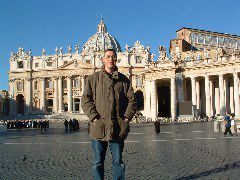 If this is Thursday, this must be the Vatican! Today we visited the Vatican Museum, the Sistine Chapel, and the Basilica of St Peter. Jonathan Boardman, chaplain of All Saints, the Anglican church in Rome, gave us a tour of some of the principal works in the museum, and talked about the paintings in the Sistine Chapel. Although I have been in the Chapel twice before, this was the first time since the major restoration of the Michelangelo frescoes. It was also the first time I had really considered the overall scheme of the decoration: the ceiling depicting scenes from the Creation to the Flood; the pairs of pictures on the side walls by a number of earlier artists (Old and New Testament scenes in pairs, where the OT scene is in some way a ‘type’ for the NT one opposite it); and, of course, the Last Judgement on the ‘east’ wall. Here we see Peter and Paul as the strong men of Christ, sporting their perfect, resurrected, bodies (or at least, as Jonathan later noted, perfect in the eyes of Michelangelo; we might not all envisage our perfected bodies as those of East German athletes!).
And then to the Basilica of St Peter. The vastness of this building never ceases to amaze. I remember visiting as a schoolboy in 1973. Our guide asked a fellow pupil to walk over to one of the columns and touch the carving of a dove that seemed a few feet off the floor. As he got nearer we realized that far from having to reach down to it, he could not in fact reach it by stretching up. The perfect scale of the building had confused our senses. On the other hand, you do have to wonder what the fisherman from the Sea of Galilee might have made of all this splendour and pomp.
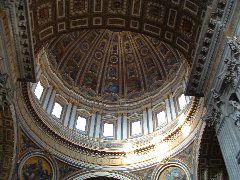 This is a place where the claims of the bishops of Rome are most evident, from the ‘Tu es Petrus’ mosaic in massive letters written around the base of the dome, to the monuments recalling papal declarations such as the ‘immaculate conception’, and above all the grandiose memorials to a swathe of popes in the main basilica. These explicitly proclaim the primacy and universal immediate jurisdiction of the see of Rome. As an Anglican, I find it very easy to challenge the show of pride and opulance, and the claims to power that these buildings and memorials present (whilst not forgetting that my own church has its own grand buildings, monuments and claims).
As a contrast to all the show it is a welcome change to descend to the crypt. Here you stand more or less at the level of the basilica built in the time of Constantine in the first half of the fourth century. Immediately beneath the dome and the high altar (with its great baldachino designed by Bernini, and forged from bronze taken from the Pantheon of ancient Rome) stands the tomb of St Peter. Not his actual tomb, I think, which lies another level down, not accessible to the general public, but a shrine to the saint, nonetheless. This is the place to stand and give thanks for the life of Simon son of Jonah, to whom Christ gave the nickname ‘Cephas’ or ‘rock’ (‘petros’ in Greek), and to pray — especially at this time, in the middle of the Week of Prayer for Christian Unity — for the unity of the Church, union amongst Anglicans and union with our other separated brothers and sisters, and especially in this place, union with the see of Rome, with the successors of St Peter.
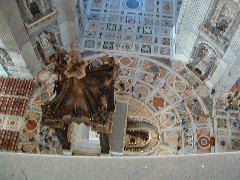 When you stand before, or over, the tomb of the leader of the Apostles, you are taken back to New Testament times, to the days 2000 years ago when Jesus walked beside the Sea of Galilee and called Simon, son of Jonah, to follow him, to the days when Simon Peter acclaimed Jesus as the Messiah, the Christ, disowned him, and was forgiven, to the days when he preached the resurrection of Christ in Jerusalem, and then through the eastern Roman Empire, before ending up in Rome, to suffer and die as a witness to the kingdom of God proclaimed by the Jesus he had known. Here, in the crypt of the basilica, the pomp of the main church is forgotten — the roof is low, the walls are plain. Here are the simple tombs of many of the popes, placed close to where they believed Peter was buried. Here it is possible to forget the grandeur that is just a few feet over your head, and to recover a simple spirituality, and the simple message at the heart of what Christians believe, and to which Christians down the ages have borne witness.
It is easy to say that the claims of Rome are misconceived and misunderstood, but even so I find myself not unwilling to allow a primacy of honour to this ancient see, effectively the only one remaining of the ancient patriarchates of Jerusalem (the see of James, the brother of Jesus), of Alexandria, and of Antioch, all three long since having lost their Christian hinterland. This primacy would not be the primacy of the main basilica, a primacy of marble and costly show, a primacy of universal jurisdiction or of infallible pronouncements; rather it would be like the crypt, plain and simple, unadorned, the servant of all, exhibiting moral strength, uncorrupted personal character, and the love of God the Father and of the created world, preached by the carpenter of Nazareth.
0 Commentson the feast of St Agnes
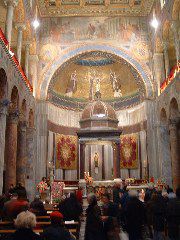 Today we visited the church of Sant’Agnese fuori le Mura — St Agnes outside the Walls. It’s the feast day of St Agnes, a young girl of 12 or 13, who was killed in Rome for her Christian faith near the end of the persecution under the Emperor Diocletian, around the year 304. This is the church where she is buried, and a great service is held in this church on this her feast day.
At the start, two tiny (live) lambs, garlanded and bedecked with flowers are carried into the church on trays and placed on the altar. They are blessed, and then, during the Gloria, carried out in procession, and away to a convent. When they are old enough to be shorn, their wool is woven into the palliums which the Pope gives to all Roman Catholic Archbishops (as a symbol of their metropolitan jurisdiction).
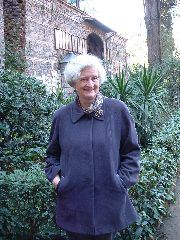 Margaret Visser has written an interesting book about this church and the cult of St Agnes, The Geometry of Love (see it at Amazon UK, and there are some pictures on her website). After the service one of our group spotted Margaret Visser in the church and she was kind enough to come and talk to us about the church and the book.
Here we worshipped; here we prayed, at this place (as Eliot wrote about Little Gidding) where prayer has been valid; to stand and pray at the shrine of this young girl, martyred for her faith 1700 years ago today; to stand and pray with this young girl and for this young girl, who surrendered her life rather than offer incense and prayers to pagan gods; to stand and pray with the countless numbers who down the centuries have stood in this same place, before the tomb-chest of Agnes, and who have similarly offered their prayers — this is a moving experience, although one rather wonders what she would have made of the great church and the great service held in her name, let alone the incense offered at the altar over her tomb!
0 Comments