Modelling Liturgical Presidency
A Tale of Two Contrasting Consecrations
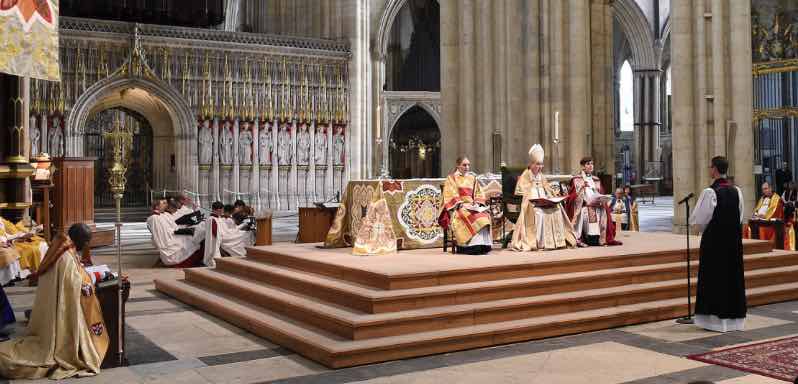
The ‘Octave’ from the feast of the Conversion of Paul (25 January) to Candlemas (2 February) was an eventful one for the Church of England. York Minster was the venue for the two episcopal ordinations (or consecrations) which were the focus of this eventfulness. It provided the Minster with a wonderful opportunity to demonstrate why English cathedrals have experienced such growth over the past decade. The fusion of space, music, movement and colour merged to provide that elusive and indefinable, but tangible, experience we often describe as ‘transformative’. The balance, pace (and timing) left you with the craving to come back for more.
Peter Moger, the Minster’s Precentor, deserves buckets of sympathy and admiration in equal measure. It requires a certain degree of insight and experience to craft acts of worship such as these, where the overall impact is memorable – as opposed to being overloaded and exhausting. In a previous life, I was responsible for arranging several consecrations in the southern province. I know the complicated terrain intimately: the reciprocal horse-trading; the endless telephone calls; the missed deadlines; proof-reading in the wee small hours; managing conflicting expectations; not to mention the sleepless nights. These are all inescapable in the build-up to these occasions. Despite the fail-safe rehearsal plan, there is always the potential for ‘something’ to go awry on the day – objectors notwithstanding!
My concern is with the strikingly different manner in which liturgical presidency was modelled at the two consecrations. The pretext for this difference is well known and hardly needs rehearsing here. However, it was more than apparent that, behind all the agonised exegesis of the Five Guiding Principles and the desire to model generous restraint, something vital was lost in the second of the two consecrations. The cohesive shape and flow of the liturgy felt as if it was creaking under the weight of unrealistic expectation – precisely because the presidential modelling seemed disorientated.
The first of the two consecrations (Libby Lane’s) was a model of how to order an episcopal ordination. Reactions to the sermon have been mixed; but there is no doubt about the theological, ecclesiological and liturgical assumptions which undergirded the rite. A sense of cohesion was self-evident in the Archbishop’s presidency, complemented by the appropriate liturgical ministry of others. As the introductory note to the Eucharist in Common Worship acknowledges:
The unity of the liturgy is served by the ministry of the president who, in presiding over the whole service, holds word and sacrament together [my italics] and draws the congregation into a worshipping community. The president … expresses this ministry by saying the opening Greeting, the Absolution, the Collect, the Peace and the Blessing. The president must say the Eucharistic Prayer, break the consecrated bread and receive the sacrament on every occasion.
The Archbishop’s modelling of this ideal felt organic, innate and contributed to a sense that, as the congregation was carried by the peaks and troughs of the liturgy, as different voices spoke, silences emerged, processions moved and music intensified the prayers and hopes those present, the unambiguous centre of gravity was the Archbishop as liturgical president.
In the second consecration (Philip North’s) it was far less clear how the unity of the liturgy was being served. Some will say, inevitably, that the lack of presidential cohesion experienced on this occasion was an all-too-real reflection of the uncharted ecclesial, liturgical and theological territory being negotiated. But need it have been so?
Quite often, it felt as if the fundamental question of how presidency of the whole liturgy would be expressed to give unity and cohesion to a great celebration, sank under the accumulation of so many other competing demands. The legal and canonical rights of the Metropolitan were well emphasised, as were questions of who would, and would not, lay hands on the candidate; not to mention the perilous prospect of treading a safe path through all the media discussion about purity and taint. The (doubtless unintended) outcome was that the Archbishop’s stated desire to model ‘gracious restraint’ was undermined by the apparently random manner in which he seemed to appropriate aspects of the presidential role.
Instead of there being a centre of gravity in the liturgy, there was an impression of two bishops competing for the same space in a liturgical game of musical chairs. The one who greeted the congregation, absolved them and then blessed them at the conclusion of the liturgy, did not recite the Eucharistic Prayer, break the consecrated bread, or invite the congregation to receive communion. The notion of the unity of word and sacrament being embodied in the president was fractured. The focus of liturgical unity was obscured.
I am left asking why the Bishop of Chichester could not have been granted the Archbishop of York’s commission to preside over the whole rite. The Archbishop was always going to be a visible participant, exercising his ministry at key moments (as preacher and as Ordinary who received the oaths of due obedience). Such a liturgical gesture of gracious restraint, and respect for theological conviction, would not require him to cede his authority as Metropolitan in his cathedral. But it would have enabled him to allow the unity of the liturgy to be served by the president, where the holding together of word and sacrament is embodied in one bishop, who is the centre of gravity for the worship of the whole people of God.
At a less theoretical level, it is largely assumed that cathedrals exemplify good practice. And they do – York Minster included. But I have this awful feeling in the pit of my stomach that quite a number of clergy, lay readers and others from the Blackburn Diocese (and further afield) will have come away from York Minster on Candlemas day thinking that the model of ‘presidency’ they witnessed at Philip North’s consecration is a good thing (even down to wearing cumbersome copes instead of the traditional Eucharistic vestments usually worn for the Eucharist in the Minster). ‘Let’s give it a try next Sunday,’ they will be thinking!
Much parish worship in the Church of England is less than the transformative experience it should be at present, precisely because there is a lack of theological insight; a paucity of spatial and artistic imagination; but most of all, confusion about what constitutes good presidency – and how good presidency enables the whole people of God to fully celebrate the mysteries of faith in the sacrament of unity. If this can be understood – and modelled properly – before the next consecration of a traditionalist bishop, it will be for the better health of the mission of the entire Church of England.
Simon Reynolds is the author of Table Manners: Liturgical Leadership for the Mission of the Church (SCM, 2014).
Photo by Clive Lawrence, copyright Diocese of Blackburn
4 CommentsAdditional Texts for Holy Baptism (GS 1958A)
The Agenda for the February sessions of the General Synod was published recently. On Thursday afternoon, the Alternative Baptism Texts return to the Synod after the revision committee stage:
The following items (full details of which are contained in Special Agenda II – see page 9) will be taken:
600 Alternative Baptism Texts (GS 1958A)
– Report of the Revision Committee (GS 1958Y)
and the note on page 9 says:
ALTERNATIVE BAPTISM TEXTS (GS 1958A)
Article 7 Business
Consideration of a Report by the Revision Committee (GS 1958Y)
The Chair of the Revision Committee (the Bishop of Truro) to move:
600 ‘That the Synod do take note of this Report.’Notes:
1. Notice of motions for re-committal under the provisions of Standing Order 77(a) must be given in writing to the Clerk to the Synod by not later than 5.30pm on Tuesday 10 February 2015 (Standing Order 10©). Any such motions will appear on a Notice Paper.2. If no such motion is carried, the liturgical business will automatically stand committed to the House of Bishops under Standing Order 77(f).
The texts (GS 1958A) and the report of the Revision Committee (GS 1958Y) can be found with other papers for this group of sessions here.
3 CommentsLiturgical dates for 2015
There is a tradition of announcing at this time of the year the principal dates of the ecclesiastical calendar.
Greg Kandra at ‘Don’t forget to chant the date of Easter this Sunday’ lists the dates and the usual formula.
Of course nowadays you can just use a printed almanac – or even an online one such as mine.
0 CommentsReligious Architecture
It is intended to say quite a bit at Thinking Liturgy on the subject of church architecture. Meanwhile, here is an interesting collection of pictures of
PHOTOS: See the award winners for stunning religious architecture
Take a visual journey of sacred spaces around the world through the winners of the 2014 International Awards Program for Religious Art & Architecture, given out by Faith & Form, the interfaith journal on religion, art and architecture.
A five-member jury of artists, architects, liturgical designers and clergy handed out 32 awards from 134 submissions.
From the press release:
“Jury members agreed that religious art and architecture are flourishing throughout the world, and that artists, architects, liturgical designers, students, and others are exploring ways to balance tradition with new demands of religious practice. The landscape of sacred space is changing, along with dramatic shifts in organized religion.”
The designs will probably not be welcomed by all, and they include places other than Christian ones. They are also largely, but not exclusively, North American.
0 CommentsAdvice to "traditional worshippers"

In an article Dear Traditional Worshippers blogger “Jonathan” gets to grips with some of the issues between “traditional” and “contemporary” worship. Writing from an American Methodist perspective he lists some of the things that are lost by “contemporary” worship,
It’s devastating to see what’s happened to worship in the church. You’re right. The blindness surrounding the issue is astounding. The insistence that the common trends of the day are most fitting for public worship is wrong and short-sighted. It’s grieving that most churches now let Christians choose to not learn the historic creeds, or the great tradition of hymns and songs, or the great privilege of praying together and reading Scripture together. The commercialization of our sacred time, well, it’s nothing short of tragic. Yeah, we’ve sacrificed so much of who we are.
I know you feel like it’s been stolen from you. I know the pain runs deep. I know you’ve lost jobs, friends, family, congregations. I know you’ve paid a dear price.
I hear you. I’m one of you. I get it.
But he continues
But here’s the deal. We’ve become part of the problem.
It’s not enough to say “we like it.” That doesn’t matter. The worst thing that “contemporary worship” did was come on the scene, label itself as a viable choice, and then get away with labeling the liturgy as a choice, also. But we can learn from the brokenness.
It’s not enough to say, “That was my mom’s favorite hymn.” Or, “It’s my preference.” Or, “Those were some of my best childhood memories.” It’s got to be deeper than that, or we’re just guarding our relics, our museum pieces.
It’s not about sentimentality. It’s not about taste or preference. It’s about meaning.
The bottom line is this. We don’t keep tradition because it’s tradition, or because it’s old, or because it’s comfortable.
We keep tradition because it’s worth doing. Because it anchors us. Because it’s bigger than us. Because it reminds us that we’re not alone. Because it keeps us honest. Because it helps us avoid thinking that this worship thing is all about us. Because it builds up the church. Because it lets us better engage our minds with our spirit. Because it helps us respond as the visible community.
So maybe we need to rethink our plan of action.
And he goes on to list a dozen point where action can be taken.
Definitely worth a read.
0 CommentsMore Canadian trial liturgy
I noted earlier the publication by the Anglican Church of Canada of trial Year A Collects ‘from Pentecost to the Reign of Christ’.
The Canadian Church has added considerably more resources to that page in the intervening period. It now contains
- Morning and Evening Prayer: Advent, Christmas and Epiphany
- Trial Use Liturgical Psalter
- Trial Use Collects and Seasonal Prayers over the Gifts and after Communion from Advent to the Baptism of Christ — Year B
- Trial Use Collects and Seasonal Prayers over the Gifts and after Communion from Advent to the Baptism of Christ — Year A
- Trial Use Collects from Pentecost to the Reign of Christ — Year A
In the Canadian Church each diocesan bishop can authorize the this material for trial use in their diocese, and the task Force encourages feedback on their use.
(Thanks to Rod Gillis for drawing my attention to the new material. As before, I welcome readers sending suggestions of suitable links either by email or as a comment on an existing article.)
1 Comment2014-15 Almanac
Each year since 2002 I have produced a downloadable calendar for the forthcoming liturgical year, according to the rules of the Church of England’s Common Worship Calendar and Lectionary.
The 2014–15 Almanac is now available for Outlook, Apple desktop and iOS Calendar, Google Calendar, Android devices and other formats, with your choice of Sunday, weekday, eucharistic, office, collects, Exciting Holiness lections, for Common Worship and BCP.
Download is free, donations are invited.
3 CommentsLiturgy and the 100 best Christian books
Is a story about something which didn’t happen news?
The Church Times has recently published its list of “100 best Christian books”.
Amongst these 100 works there is not a single volume containing or concerning liturgy. The closest is perhaps at number 37 The Prayers and Meditations of St Anselm.
This might be considered a strange omission in a list, particularly in an Anglican compilation, although the compilers deliberately decided to exclude the Book of Common Prayer (meaning presumably the 1662 edition) and favourite hymn books. Even so, it is surprising that there are no books about liturgy and liturgical practice included.
So I invite readers to make suggestions of books of or about liturgy that they think might have been included, and why.
18 Commentsworship or performance
This week’s editorial at Anglicans Online ponders the question When is a service worship and when is it performance?.
4 CommentsOur friend enjoys the cleansing end-of-the-day, beginning-of-the-week feel to Compline on Sunday evenings. She, like us, views the services of the Daily Office as worshipful expressions of our beliefs and faith. Imagine her surprise when she sat down with the pew sheet: The second word on the inside cover was ‘performance’.
Compline as performance? She brought us the pew sheet. We read it through. Unfortunately, this time the sung service of Compline seemed to be replaced with a concert based on Compline. Soloists were named, a long biographical sketch of the conductor was included. No mention was made of the history or role of Compline in the worship life of our tradition. No mention of welcoming the congregation to a time of prayer. Perhaps we are being too picky. Perhaps it is enough the service is being offered no matter the circumstances.
We were left to ponder: When is a service worship and when is it performance? Does it matter? Should it matter?
Liturgical presidency
The term ‘president’ signifies an important shift in liturgical thinking. The words ‘priest’ and even ‘minister’, used in the 1662 Book of Common Prayer, appear to have a perfectly clear and adequate meaning. But biblical understandings of priesthood encompassed ideas of a specially-selected person who might carry out functions on behalf of people from which they might even be excluded. The Holy of Holies of the Temple was reserved for the priesthood, who performed their functions largely in secret.
A president acts in the midst of a gathering of the people of God. The most ancient Christian churches are modelled on the spaces for civil gatherings of the Roman Empire. This is our model for the setting of the Eucharist.
Throughout Christian history, there has been a tension between the roles of priest (ministering on behalf of the people in a holy place) and president. Towards the end of the Middle Ages, with the norm for the Western Mass being the daily duty of clergy, priesthood was paramount, and presidency could virtually disappear.
- The priest might be alone, save for one server
- He had his back to the people
- Some of the prayers were silent, or even deliberately secret
- Latin, a religious language used to address God, was used in preference to the vernacular used to address the people
- The priest might be separated from the people by a screen, a choir formed of a religious community or both
- Women were kept away from the altar, and only men would serve
The Reformation began a reversal. In the BCP, English is employed, and the priest must speak audibly. But Cranmer’s idea of a gathering around the holy table set lengthwise in the church with the president at the ‘north side’ soon lost its meaning when the tables were returned to the spaces formerly occupied by medieval stone altars.
For the Reformers there were few clear models of presidency at hand, and this meant that the BCP does not provide adequate guidance. The BCP Eucharist begins, not with an act of liturgical presidency, but with the private devotion of the priest. The priest alone says the Lord’s Prayer, and the people are not even invited to respond with the ‘Amen’. They respond only after the Collect for Purity. It seems as though the first task of the priest in this service is not presidency, but, once he has purified himself with his devotions, to admonish the people by reminding them of the Ten Commandments. Traditionally, the priest only turns to face the congregation at this point. What picture must go through his mind as he turns from the vision of saints in a sunlit east window to the people below in the nave? Is he Moses, coming down the mountain from his encounter with God to deliver the law to a disobedient crowd of golden calf worshippers?
Presidency is also not very evident at the beginning of the BCP Order for the Burial of the Dead. The priest intones a series of biblical texts as the coffin is brought into church, startling the congregation with a booming voice from the back declaring that ‘I am the resurrection and the life’. It isn’t a good presidential act. And Morning Prayer opens not with a greeting, but with the recollection of ‘the wicked man’. That glorious address to the congregation, ‘dearly beloved brethren’, is lost in what appears like a great deal of finger-wagging. The legacy of centuries of inadequate models of presidency enshrined in the texts of the BCP has given those called to minister a poor model of how to lead worship. What is more, the need to keep to a faithful adherence to the words of the Prayer Book, without additions, made it difficult to assert a presidential role.
Today the president at the Eucharist is bidden to address the people and greet them in the name of the Lord, inviting their response by establishing the entire body as a gathering for worship. This, critically, requires the use of modern English. The retention of ‘King James English’ at this point is disastrous because, whilst we might like to address our creator reverentially as ‘Thou’, for the congregation to use the same expression (and with thy spirit) when responding to the vicar sounds quite over the top. (The post Vatican 2 Spanish translation of the Latin Mass got it right when the people’s response was ‘Y con tu espiritu’ rather than the respectful address in the third person used when speaking deferentially to superiors.)
Fortunately Common Worship encourages flexibility in the opening greeting. The president may add other words of greeting, and may then, after the greeting, give further words of introduction in order to enable and enrich the participation of the entire gathering. The baptism party are acknowledged, and the candidate is named. Returned former parishioners can be welcomed, and significant visitors are pointed out. The president may introduce himself or herself and name others who will take a significant role in the service. The occasion for celebration is highlighted. In short, the president initiates ‘The Gathering’ of all who will share in worship and sets out the journey.
With this beginning, the congregation will look to the president to keep them on course throughout the service. The days when the liturgy proceeded without announcements, hymns were simply listed on the board, and the regular worshippers always knew what came next are over. That separation of ‘sheep’, who knew what would happen next, and ‘goats’, who were completely at sea, is unacceptable. The president realises the importance of including everyone so that they are able to participate; kneeling, sitting, standing, speaking without embarrassment. This has the advantage of allowing flexibility into the service without giving the impression that somehow things have gone wrong when the usual order is varied.
Some may object that they do not want what can appear like an unnecessary running commentary on a familiar service. But the newcomers must be invited in. Indeed, this idea is paramount in gospel stories which provide models for the Eucharist. At the feeding of the 5,000, when the disciples want to send the people away, Jesus gathers the crowd to sit on the grass to be present for the breaking of bread.
The presidential role of Jesus at the Last Supper, as Passover is celebrated, is clear in every depiction of the event. The risen Christ takes that role again, at Emmaus, and on the shores of Galilee when he invites the disciples to ‘come and have breakfast’. Jesus presides at the breaking of bread, and gives us the model for the Christian Eucharist. The mould, of the old priesthood at the Temple, is broken, for the veil of the Temple has been torn apart. It is not the business of the Christian priesthood today to try to put it back.
9 Comments